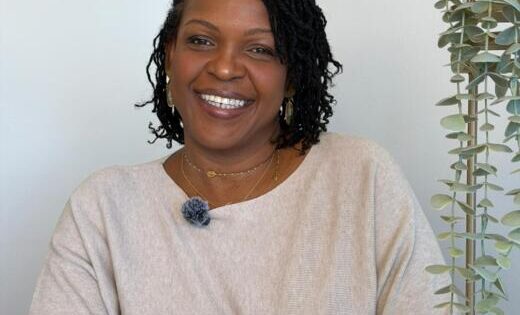



The stage lights dim. A solitary figure stands center, her body coiled with potential energy. As the first note sounds, something ancient and immediate unfolds; a story told through limbs that remember what the mind has forgotten. This is where Esie Mensah lives, in the sacred space between movement and meaning, between heritage and healing, between what was and what could be.
What if I told you that the most powerful revolutions aren’t fought with weapons? That the deepest healing on dance floors where ancestral memories stir awake? These are the foundation of our Woman Empowered’s work, a two-time Dora Award-nominated choreographer who has transformed personal pain into collective liberation…
“I was moving in my mom’s womb.”
When Esie speaks of her earliest dance memories, she’s not being poetic, before technique, before training, before conscious choice, there was simply the rhythm of existence itself, passed down through generations.
Family was the first space. The first stage. The first audience. In those early years in Hamilton, Ontario, Esie was learning to belong. “My family ensured that we knew our culture,” she reflects. For 17 years, she immersed herself in traditional Ghanaian dance with the Ewe Canadian Cultural Organization of Ontario, not realizing these movements were charting her future.
Three years into Women’s Studies and Cultural Studies at McMaster University, something shifted. The academic path her family expected collided with the artistic calling her soul demanded.
” I went to McMaster and pulled back to follow my passion in my third year. It was thanks to my sister; she convinced my parents to let me follow my heart.” This decision was life-altering.
At 21 years old, Mensah stepped into George Brown College’s Commercial Dance Program, encountering ballet and jazz for the first time. “Six months into the program, and the feeling that came over me is that I was exactly where I was supposed to be.”
Belonging didn’t guarantee success. After the initial excitement of being “the new girl” faded, Esie faced a devastating 2½-year period without work. The industry’s limitations became painfully clear during a trip to China, where she was told, “I am too dark for television.”
“I accepted that even though I learned that there were a lot of Africans in China,” she recalls, the memory still raw. “I was awarded an opportunity to go to the States, but fear stopped me, and I was glad it did. It kept me home.”
What happens when the doors you thought would open remain firmly closed? When the path forward seems blocked by circumstances beyond your control? This is where Esie’s story diverges from the typical artist’s narrative.
“As soon as I came back from China (2012), that is when my real life began.” During this period of rebuilding, she developed her Afrofusion technique, merging: African, urban, Latin, Caribbean, and modern dance forms. She founded Black Stars Collective in 2012 and Esie Mensah Creations in 2015, establishing platforms for storytelling through movement for the African diaspora.
Her work began to address shadeism and colourism within the Black community, exploring these painful dynamics through productions like “Shades” and films such as “A Revolution of Love” and “TESSEL.”
“I had a chance to dig into my ancestral history. I can tell the stories that we need to hear, not the ones that we want to hear. As a community, we need a deeper healing.”

This commitment to difficult truths has become Mensah’s signature. Whether choreographing for major artists like Rihanna and Drake, creating for institutions like the National Ballet School of Canada, or developing original works that tour internationally, her approach remains rooted in transformation.
The philosophy; dance as excavation
“What are you being intentional about when you are dancing? When audiences engage with your work, what transformation do you hope they walk away with,” I asked?
“Honesty feels like a big intention,” Mensah responds. “What I find as an artist that is very hard to do is be vulnerable and honest. You cannot create honest work if you are not being honest with yourself.”
This honesty extends to her teaching methodology. “In my class, I tell my dancers to take that trauma, that pain, and place it in a body part, and dance from that body part.” The approach is revolutionary precisely because it’s so simple. Rather than ignoring pain, or pretending it doesn’t affect performance, Esie encourages dancers to integrate their experiences fully into their movement.
“There are experiences that have happened in my life where I had to navigate grief, how it affected my soul, and my body. I had to learn how to channel that grief in my heart.” Esie’s work addresses: the weight of migration, diaspora, or historical trauma, acknowledging how these forces shape both individual bodies and collective experiences. “There are many systems at play that distract us from understanding who we are in this world; I would love it if more people could tap into something in ourselves and leave this world lighter. Get rid of all that doesn’t serve you or help you.”
As 2025 Artist-in-Residence at Fall for Dance North in Toronto, Afrodiasporic Movement Program Lead at Canada’s National Ballet School, and creator of new works including Scott Joplin’s “Treemonisha: A Musical Reimagining” premiering in Chicago, Esie continues to expand her influence. Perhaps her most revolutionary act remains her commitment to healing through art. “People have said to me, ‘Your work has stayed with me,’ or ‘Your work found itself inside of me.'” These testimonials reveal the profound impact of Esie’s approach.
In a world that often values spectacle over substance, technique over truth, Esie Mensah offers something different, a dance that moves souls. An art form that entertains and heals.
What stories will your body tell when you finally give it permission to speak? What healing might unfold when you allow movement to excavate what words cannot express? These are questions for anyone who has ever felt the gap between who they are and who they might become.
Experience the transformative power of Esie Mensah’s choreography and discover how African diaspora dance is revolutionizing healing through movement. Follow her journey as a Black Canadian dance pioneer and witness the evolution of Afrofusion technique that’s changing how we understand: art, identity, and belonging.
Stay in the loop with exclusive news, stories, and insights—delivered straight to your inbox. No fluff, just real content that matters. Sign up today!