


“Without it, you won’t have a legally recognized identity. You won’t have rights. You won’t be able to access services, work, or participate in society.”
The rain slicked the Toronto streets as Maya pressed her forehead against the glass door of another government building, her reflection showing desperation. Inside, officials sat behind computers, indifferent to her plight. At 68, she had lived a full life as: a teacher, mother, and community volunteer, but today, she was invisible, a non-person in the digital ecosystem that had replaced her country.
“I’m sorry, Mrs. Chen,” the clerk said without looking up. “Without digital ID verification, we cannot process your pension application. The system requires biometric authentication.”
Maya’s hands trembled, “But I’ve been coming here for thirty years. Everyone knows me here.”
The clerk finally met her eyes, a flicker of sympathy quickly replaced by bureaucratic resignation. “The old system is offline. It’s digital ID, or nothing. That’s just how it is now.”
Outside, Maya joined others huddled under awnings: seniors, those with certain religious objections, technology holdouts, and privacy advocates who had refused the digital implant. They formed a growing underclass, unable to access healthcare, banking, or government services. They were the unconnected, living in a digital shadow state that most Canadians never saw, because the system was designed that way.
What few Canadians realize is that our government’s quiet push toward digital ID isn’t happening in isolation. It’s part of a coordinated global framework aligned with Agenda 2030’s sustainable development goals. While marketed as a solution to identity theft and inefficiency, the system serves a deeper purpose; comprehensive data integration that will eventually govern every aspect of human activity.
The official narrative speaks of convenience, security, and inclusion. The unspoken reality involves creating an infrastructure where every: transaction, movement, and interaction becomes traceable, trackable, and controllable. This is documented in government procurement documents and international partnerships that rarely make headlines.
When I first began investigating this trend, I approached it with journalistic skepticism, but as I dug deeper, interviewing privacy advocates, former government officials, and technology experts, a pattern emerged that disturbed even my experienced understanding of how policy evolves.
What is most fascinating about the digital ID implementation strategy is how it exploits fundamental aspects of human psychology. The approach creates what psychologists call an “information gap.” We’re told just enough to feel informed while critical details remain obscured, driving us to fill the gaps with assumptions that usually favour the proposed system.
The marketing relies heavily on storytelling techniques that transport us to a future of effortless interactions, where: banking, healthcare, and government services flow seamlessly. This narrative bypasses our rational analysis and appeals directly to our intuitive brain’s desire for simplicity and order.
The information is presented in carefully “chunked” pieces: small, digestible announcements that don’t overwhelm our cognitive processing. Each step seems reasonable on its own: digital driver’s licenses, enhanced passport systems, online verification for government services. Only when viewed collectively does the full architecture emerge.
Emotional triggers are masterfully deployed. Fear of identity theft and fraud activates our primitive brain’s survival instincts. The promise of security and convenience appeals to our neocortex’s logical processes. Meanwhile, social proof and authority bias lead us to accept what “experts” and “other developed countries” are doing.
Looking internationally reveals both the possibilities and perils of digital ID systems. Estonia’s e-ID demonstrates remarkable efficiency and citizen empowerment. India’s Aadhaar system shows how quickly such infrastructure can expand beyond original intent. China’s social credit system illustrates the endpoint of comprehensive digital identity governance.
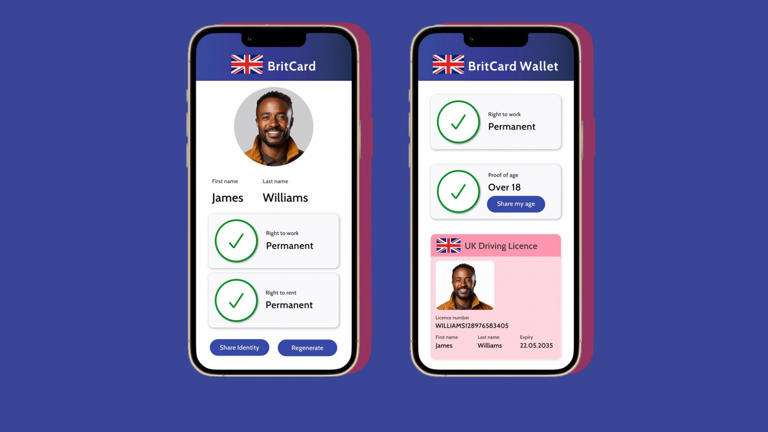
Across the Atlantic, the United Kingdom is quietly transforming its relationship with citizen identity through a digital ID system that, while framed as voluntary for most services, carries a stark mandatory core; without it, legal employment becomes impossible. Under the government’s plan, employers will be required to verify a worker’s right to hold a job exclusively through digital ID, effectively phasing out traditional methods like National Insurance number checks. This creates an invisible wall where those who refuse, or cannot participate (whether due to privacy concerns, lack of technology access, or principled objection) are locked out of livelihood itself.
While officials promise alternatives for the digitally excluded, critics warn that the system inherently marginalizes vulnerable populations: the elderly, those with disabilities, low-income communities, and individuals without smartphones, or stable internet.
Beyond the immediate barrier to work, the digital ID infrastructure threatens to expand into a pervasive tool for monitoring daily activities, linking biometric data to financial transactions, movement, and even online speech. This mirrors global patterns where digital ID systems, initially marketed as conveniences, gradually enable state and corporate surveillance under the guise of security and efficiency, raising urgent questions about autonomy in an era where participation in society is increasingly conditioned on surrendering to digital verification.
What connects these seemingly disparate implementations is their shared foundation in data integration and the gradual elimination of anonymous transactions. Each system creates what experts call “function creep” expanding beyond original purposes to encompass new functions never initially disclosed to the public.

The Canadian approach follows this pattern, beginning with voluntary applications for specific services while building the infrastructure for eventual universal implementation. The COVID-19 vaccine passport system served as both trial and precedent, demonstrating how quickly Canadians would adopt digital verification for everyday activities.
Beyond the obvious privacy concerns lie deeper implications for human autonomy and social organization. When every transaction requires digital authentication, cash becomes obsolete. When physical presence can be verified remotely, freedom of movement diminishes. When identity becomes inextricably linked to state-approved digital credentials, dissent becomes technically possible, but practically impossible.
The most vulnerable populations face the greatest risks. Those without reliable technology access, digital literacy, or official documentation find themselves increasingly excluded from essential services. Meanwhile, the system creates new possibilities for discrimination and control that are technically neutral but practically biased.
During my investigation, I spoke with a former government security consultant who requested anonymity. “The public discussion focuses on the wrong questions,” they told me. “We debate whether the system will be mandatory while ignoring how it will inevitably reshape power relationships in society. Digital ID is about creating a new framework for human interaction that prioritizes administrative efficiency over individual autonomy.”
This isn’t an argument against all digital innovation, or against solving legitimate problems with identity verification. The current system has real flaws that leave people vulnerable to fraud and exclusion. A well-designed digital ID system could potentially enhance security while expanding access to services.
The critical question isn’t whether digital technology can improve identity management; it clearly can. The question is whether we will implement these systems with meaningful democratic oversight, robust privacy protections, and respect for human autonomy. Will we design systems that serve citizens, or ones that citizens must serve?
As communities, we need to develop greater media literacy around these issues. We must look beyond marketing narratives to examine implementation details, legal frameworks, and technological architecture. We need to ask who benefits, who pays, and what happens when things go wrong.
The conversation around digital ID is about what kind of society we want to become. Do we value convenience over privacy? Security over freedom? Administrative efficiency over human dignity?
These questions are being answered right now through: policy decisions, procurement processes, and technological infrastructure development, with remarkably little public input, or awareness.
Maya’s story shouldn’t become our collective future. The challenge before us is to harness technology’s benefits while preserving fundamental rights and values. It’s a delicate balance that requires vigilance, participation, and an unwavering commitment to human dignity in an increasingly digital world.
The door is still open for meaningful public engagement. The question is whether we will walk through it before it closes for good.
Stay in the loop with exclusive news, stories, and insights—delivered straight to your inbox. No fluff, just real content that matters. Sign up today!