

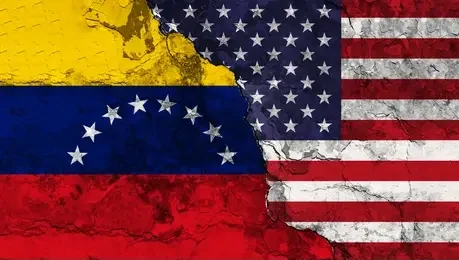

Growing U.S. military activity across the Caribbean has increased anxiety throughout the region, especially after a surge in American forces near Trinidad and Tobago. The buildup follows years of strained relations between Washington and Venezuela, tensions that deepened once Donald Trump returned to the White House in 2024. Venezuela’s recent presidential election added fuel when the winning candidate clashed with Trump, who openly supports the opposition leader and praises him as a partner in restoring what he calls “regional security.” For many observers, U.S. military expansion appears designed to pressure Caracas rather than protect the Caribbean.
Dr. Tamanisha John, a professor at York University, explored this issue in a September 10th, 2025 Black Agenda Report article titled “The Historical and Contemporary Role of Neocolonial Caribbean Governments in Supporting U.S. Militarism and Imperialism in the Region.” She later expanded on these ideas during two sessions of the Caribbean Community Study Group, organized by the Caribbean Solidarity Network and hosted at A Different Booklist in Toronto.
“The silence of Caribbean governments, their lack of condemnation and investigation of the attack, speaks for itself.”
Dr. John highlighted a September 2 U.S. missile strike that hit a boat the State Department labeled a Venezuelan “narco-trafficking” vessel. Twelve people died. American officials released no evidence to support the charge, yet regional governments remained quiet. Dr. John warned, “The silence of Caribbean governments, their lack of condemnation and investigation of the attack, speaks for itself.”
Study Group members raised two guiding questions for Caribbean communities:
- Should we support states pushing back against imperialism even when they fall short of our ideals?
- How does this shape our wider struggle for justice?
These questions echo larger conversations across the region. Many Caribbean thinkers argue that Washington’s renewed military focus in the hemisphere mirrors past patterns that sidelined Caribbean agency.
- Andy Knight, Professor of International Relations at the University of Alberta and former director of the University of the West Indies Institute of International Relations, underscored this point. He reminded the audience that the Caribbean has long promoted itself as a Zone of Peace, a principle rooted in sovereignty and collective security. “The Caribbean must not be militarized or used as a pawn in power struggles between the United States and other actors in the hemisphere,” he wrote. Knight pointed to the 1983 U.S. invasion of Grenada and its long shadow over regional unity. His message was clear: “Our seas are not battlefields; our islands are not launching pads. We are a Zone of Peace, and we intend to remain so.”

Any partnership with Washington, Knight argued, must rest on respect, fair trade, and climate cooperation, not military dependency, or efforts to topple governments.
When I spoke with Dr. John at York University on October 14th, 2025, she described the recent docking of the guided missile destroyer USS Gravely (DDG 107) in Port of Spain. The warship stayed for a week, positioned only 10 nautical miles from Venezuela. Although its 350-member crew has since departed, she stressed that a robust U.S. military presence remains active in nearby waters. She believes the deployment served a clear purpose: to signal Washington’s capacity to strike Venezuelan targets whenever it deems necessary.
The decision by Trinidad and Tobago Prime Minister Kamla Persad-Bissessar to allow the destroyer’s visit triggered strong public criticism. She dismissed the backlash as “useless declaration” and insisted the visit strengthened cooperation against transnational crime. Her stance revived a familiar debate: when does collaboration evolve into compliance, and when do small states lose strategic control?
As the U.S. and Venezuela continue their standoff, Caribbean nations confront urgent questions about sovereignty, safety, and regional identity. The region’s long-held vision of peace depends on leaders willing to defend it through principled action.
Stay in the loop with exclusive news, stories, and insights—delivered straight to your inbox. No fluff, just real content that matters. Sign up today!