
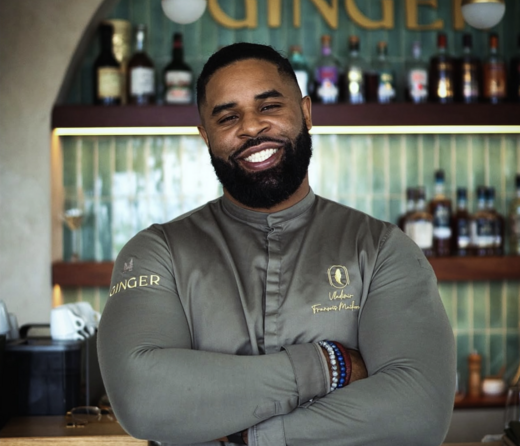

For Chef Vladimir François-Maïkoouva, the kitchen is where the past is remembered and tasted. It begins with a stool, or perhaps just the tips of toes reaching for a countertop that felt like the edge of the world.
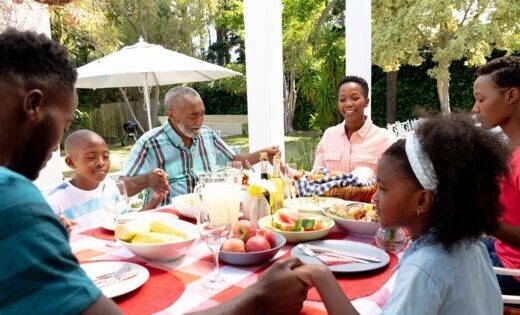
In those early years in Martinique, his mother’s kitchen was a theater of movement: the rhythmic whipping of cream, the tactile weight of rolling dombrés, and the pervasive warmth of a large family gathered around a shared hope. There, love was an unspoken dialect, articulated through the slow simmer of a pot rather than the fragility of a sentence. This is the bedrock of a man who has spent twenty-three years translating the ephemeral into the edible.
“He became a student of giants: Alain Ducasse, Marc Veyrat, and Bernard Leprince”
The journey from those domestic aromas to the sterile, high-pressure cathedrals of French haute cuisine was a transition marked by both ambition and displacement. Vladimir left the sun-drenched terroir of his birth for the grey, fast-paced suburbs of Paris and eventually the most prestigious kitchens in the world. He became a student of giants: Alain Ducasse, Marc Veyrat, and Bernard Leprince, names that carry the weight of tradition and the sharp edge of perfection.
In these kitchens, the pace changed. Life became a blur of technical precision, discipline, and the relentless pursuit of the “right” technique. He worked in the heart of Parisian excellence, absorbing the rigid codes of French gastronomy. Even as he mastered the art of the emulsion and the exacting standards of the Michelin-starred world, a quiet tension remained. There is a specific kind of loneliness that comes with achieving mastery in a language that is not entirely your own. He was becoming one of the most visible standard-bearers for Martinican cuisine abroad, yet he was performing his craft miles away from the soil that first fed his imagination.
“Be proud of yourself,” he would later say to that younger version of himself, the one navigating the intensity of those professional kitchens. “It hasn’t always been easy, and it won’t always be, but trust yourself despite doubts and challenges.”
The resolution came with a return. Ten years ago, Vladimir made the pivotal decision to go back to Martinique, to cook “at home” and reconcile his two identities. This homecoming was a strategic evolution. He took the discipline and technical precision learned from his mentors and began to apply them to the ingredients of his childhood. His style became defined as “refined, métissée and identitaire” a conscious expression of mixed cultural roots that refuses to choose between the elegance of France and the vibrant soul of the Caribbean.

His creative process is a slow, meditative unfolding. It does not start with a recipe book, but with an emotion, a flavour, or a memory. He observes. He smells. He touches. In the quiet theater of his mind, he sketches the plate, running through the composition dozens of times before a single ingredient is touched in the real world. He is looking for a precise result, a way to reconstruct a memory so faithfully that the diner feels the same warmth he felt standing on his tiptoes in his mother’s kitchen.
Today, as the Executive Chef of Ginger, he stands at a crossroads of global recognition. His upcoming appearance at Montréal en Lumière 2026 is a diplomatic mission. At Le Monème, alongside Chef Cédric Deslandes, he will present a five-course menu that serves as a bridge between Martinique and the world. He carries the responsibility of representing a region “Extraordinarily rich in culture, history, and identity.” He is part of a generation of chefs demanding that Martinique be seen as a “sun-and-sea destination,” as well as a serious gastronomic territory.
Yet, for all the international accolades and the high-profile stages, Vladimir remains tethered to the concept of transmission. He finds his ultimate reward in the satisfaction of the guest; the silent, emotional feedback that validates the years of energy invested. He watches the next generation of chefs grow and find their wings, much like he did, and he offers them the same quiet strength he had to find for himself.
“He remains a man driven by conviviality, sharing, and a deep love of the land.”
His story is a testament to the fact that the most sophisticated techniques are hollow without the “soul and uniqueness” of one’s origins. To understand Vladimir’s food is to understand a life lived between two shores, a life that found its greatest strength in the vulnerability of its memories. He remains a man driven by conviviality, sharing, and a deep love of the land.
As he prepares to take Martinique’s culinary excellence to the international stage once more, his message remains resolute, a soft whisper against the noise of the industry, “Stay strong, stay intuitive, and above all, let your heart speak, because life is beautiful, no matter what.”
In the end, his plates are maps of a journey through doubt, across oceans, and back to the heart. They are a way of saying “I love you” to a culture, a family, and a younger self who wondered if he would ever be enough. Through his hands, the truth of Martinique is felt.
Stay in the loop with exclusive news, stories, and insights—delivered straight to your inbox. No fluff, just real content that matters. Sign up today!