


The room hums before the panel even begins. Kingston heat mixes with anticipation, the kind that makes people lean forward in their seats before a single mic is turned on. The IMC (International Music Conference) team moves with quiet precision along the edges of the hall, sponsors’ banners catching the light, and Shaggy (IMC Chairman, cultural legend, and unbothered strategist) hangs back quietly overseeing like a man who knows exactly what he’s building.
Today’s central question sits heavy in the air: What does it take to build a Caribbean brand that survives generations, and an algorithm that was never designed for us? The first panel answers with fire.
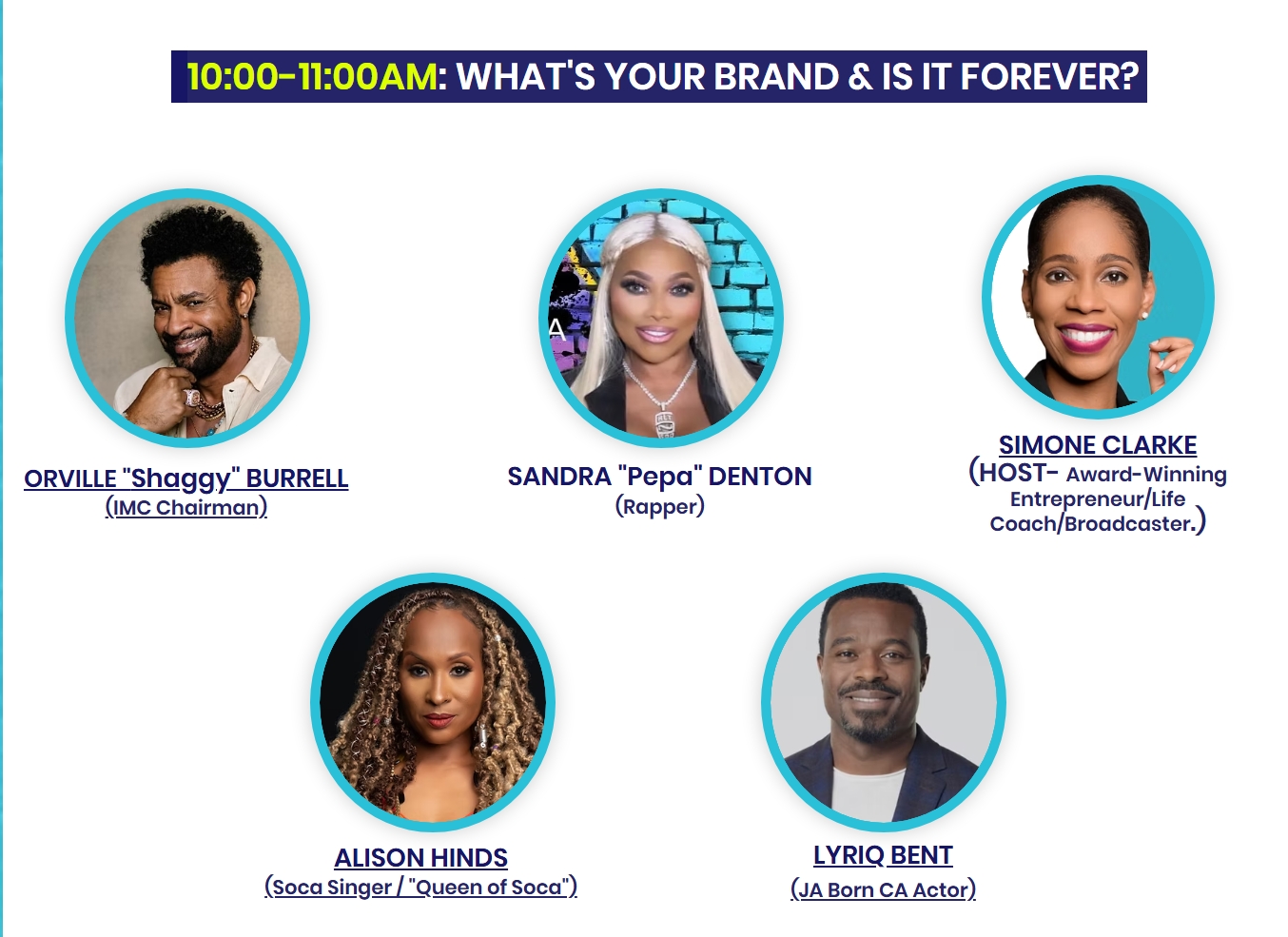
What’s your brand and is it forever?
Orville ‘Shaggy’ Burrell. Sandra ‘Pepa’ Denton. Alison Hinds. Simone Clarke, and Lyric Bent.
The stage feels like a Caribbean Avengers lineup, each icon carrying decades of cultural weight, mistakes, reinventions, and victories.
The brand is what pays you at 58.
Shaggy starts with a story that sends the room into laughter. “People think I got the name from the cartoon,” he says, shaking his head. “No, man. I was just a skinny youth with too much hair,” but the joke turns into a lesson. “When you get a hit song, it’s just a hit song. The brand is what wins. The brand is what pays you at 58.”
He breaks down branding like a man who has lived every chapter: Brooklyn dancehall clashes, BBC radio breakthroughs, global superstardom, and the quiet pivots nobody sees. “You can’t be scared to close chapters,” he says. “Fear is the killer of dreams.”
Pepa jumps in with that unmistakable Salt‑N‑Pepa authority. “We were the girls next door,” she says. “We stayed true to who we were. That’s why the brand lasted.”
She talks about being called crossover in the 80s (when crossover wasn’t a compliment) and how their global success forced the industry to expand its definitions.
Alison Hinds, the Queen of Soca, speaks with the calm confidence of a woman who has carried a genre on her back. “That title wasn’t a marketing plan,” she says. “The fans gave it to me. A brand evolves, but it must still reflect who you are.”
Lyric Bent brings the actor’s perspective, brand as boundary, brand as protection. “My brand started before my career,” he says. “It was rooted in family, privacy, and choosing work that aligned with my values.”
The panel becomes a masterclass in longevity, authenticity without stagnation, evolution without erasure, strategy without selling out.
The audience scribbles notes like tuition is due tomorrow.

Beyond the algorithm: Building Caribbean media power in 2026
Rob Kenner. Chrislyn Lashington. Kyle Denis. Brian Schmidt. Brianna Harrison. Max Glazer.
The Friday panel feels different; less nostalgic, more urgent. If the first panel was about identity, this one is about survival. The moderator opens with a simple truth, “Before we can move beyond the algorithm, we must understand what it is.”
Rob Kenner (Boomshots founder, longtime chronicler of Caribbean music) breaks it down with a metaphor only a dancehall lover could craft. “Think of the algorithm like a riddim,” he says. “It’s the beat running the internet. Everybody wants to jump on it.”
Chrislyn Lashington explains it like a strategist, “The algorithm studies you. It feeds you what keeps your attention. It’s not built for culture; it’s built for revenue.”
Kyle Denis from Billboard brings the diaspora lens. “When a Caribbean song is about to blow, I see it first in New York, Miami, and London,” he says. “Those cities are our algorithm.”
The algorithm studies you. It feeds you what keeps your attention.
Brian Schmidt from Irie FM reminds the room that traditional media still matters. “You need a multi‑prong approach,” he says. “Radio, digital, diaspora, local. The algorithm is not your boss.”
Brianna Harrison and Max Glazer echo the same warning: If Caribbean creators don’t understand the digital economy, they will be erased by it. The panel ends in strategy:
- Leverage diaspora cities.
- Use SEO intentionally.
- Sync releases across islands.
- Lead the algorithm—don’t chase it.
- Build relationships, not just content.
- Protect Brand Jamaica from digital extraction.
The message is clear; Caribbean culture is powerful, but power must be organized.
I chose to report on these two panels specifically, and with intention. Caribbean creators have always been global, long before algorithms, streaming platforms, or digital metrics existed. Shaggy says it plainly, “You have to dream bigger than the people around you.”
The algorithm panel echoes it, “You have to think beyond the islands.” This is strategic resilience, rooted in history, sharpened by necessity, and now demanded by a digital economy that extracts more than it invests.
As the panels wind down, the press team gathers in the lobby, bags of notes, half‑finished KFC, and the kind of exhaustion that only comes from learning something that shifts your worldview. Sidney is replaying quotes. Keka is already turning insights into jokes. Kyle is analyzing patterns, and I’m standing there thinking. These panels were a blueprint. Warning. Invitation, and next chapter
The next chapter is about Shyne. Readers, stay tuned for the keynote from Moses “Shyne” Barrow: From Stage to State, a story that will move you to your core. Trust me, there are more surprises in store.
Next episode: The Keynote That Stopped the Room. Don’t forget to check out Chapter 2 that can be found online NOW! Come hang out with me at the S Hotel in Kingston Jamaica.
Stay in the loop with exclusive news, stories, and insights—delivered straight to your inbox. No fluff, just real content that matters. Sign up today!