

The notification from my daughter’s school made my heart jump: “Student in your household was absent for more than one period.” She’s 14, autistic, has perfect attendance, but also at that age where everything feels more complicated. I braced myself for a difficult conversation about responsibility and consequences. When I asked her where she had been, her answer stopped me cold.
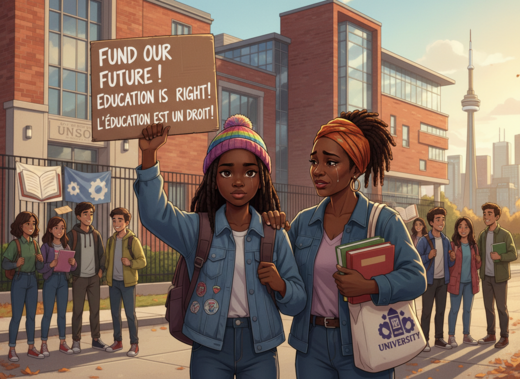
While I sat in my university lecture (a mature student juggling midterms, assignments, real-life responsibilities, and the constant worry about whether there will be enough funds to cover next semester) my baby girl was outside with a homemade sign, peacefully protesting the very cuts that threaten our future.
She was fighting for my right to education and fighting for her own future access to post-secondary learning. Fighting for every Caribbean student who dreams of something bigger than the limitations this province wants to place on us. I didn’t punish her. I told her I was proud of her. I also asked her to give me a heads-up next time, because if there’s advocacy happening, I am going to want to show up too.
This moment crystallized something I have been struggling to articulate in my advocacy work. We have gotten too comfortable. We have forgotten that everything we have, every opportunity, every program, every dollar of support, was fought by people who refused to accept “no” as a definitive answer.
The irony is not lost on me that the first accredited university was created in Timbuktu by Mansa Musa, a Black man. Yet, centuries later, we are still fighting for access to education that should be our birthright. Doug Ford’s government is making cuts that will impact current students and future scholars like my children, and too many of us are responding with resignation instead of resistance.
Not my girl. At 14, she understands what I can sometimes forget in my exhaustion: advocacy is not optional when your community’s future is on the line.
This is what healing looks like in action. Not the passive kind that happens in therapy sessions or meditation apps, but the revolutionary healing that comes from standing up and declaring that we deserve better. The healing that happens when we stop apologizing for taking up space and start demanding the space we have earned.

My daughter’s activism reminded me that legacy isn’t what you leave behind when you die, it’s what you build while you are living. Every time she speaks up, every time she shows up, every time she refuses to accept injustice as inevitable, she’s creating the world she wants to inherit.
Access to education is healing, even if you think you have nothing to heal from. Knowledge is power, and power in the right hands transforms communities. When Caribbean students succeed, we all rise. When one of us breaks through barriers, we create pathways for others to follow.
We cannot do this alone. I am putting out a call to action for our community: if you can create scholarships or grant opportunities, do it. If you cannot fund, then amplify. Share information. Show up to protests. Make noise about these cuts because silence equals complicity.
The Toronto Caribbean community has always been innovative, resilient, and trendsetting. Tell me one thing that has been culturally relevant in the past 50 years that didn’t come from us somehow. We set trends worldwide, but we are still begging for basic educational access at home. That ends now.
Collective action is healing. Advocacy is healing. I know this personally because fighting for others and myself over the past eight years has transformed my own relationship with power, purpose, and possibility. It is shown me that nobody is coming to save us, but when we become the change we want to see, people have no choice but to follow our lead.
My daughter saw what one person could do and decided to be that person. She skipped school to secure her future and ours. If she can take that stand at 14, imagine what we could accomplish together.
The lesson she taught me is simple: sometimes the most responsible thing you can do is be irresponsible to systems that do not serve you. Sometimes healing your community requires disrupting the very institutions that claim to educate you.
I am grateful to live in this moment, to witness my child’s courage, and to know that whatever happens tomorrow, we’re building something lasting today.
Stay in the loop with exclusive news, stories, and insights—delivered straight to your inbox. No fluff, just real content that matters. Sign up today!