


This isn’t just history, it’s a reminder of how far [Name] has come. Their journey, first captured in our pages, still inspires today…
The scene opens in a fourth-grade classroom, and young Emmanuel Kulu Jr. proudly presents his project, a mannequin adorned with cardboard regalia. The grade: B-. The reason: “historically inaccurate.” What happens next isn’t just a parent-teacher conference; it’s the spark that ignites a revolutionary historian.
I sat across from Emmanuel Kulu Jr. on a Zoom call as he recounted his father’s impassioned defense of King Tut’s Blackness to that teacher decades ago. I felt the familiar fire of recognition; that moment when truth confronts power, and history hangs in the balance.
This is a testament to what happens when a child of Cameroonian descent refuses to let Western narratives define his ancestry.
Emmanuel’s story begins at the intersection of two powerful lineages. His father, a player for Cameroon’s Abdominal Lions, carried the pride of the continent in his bones. His mother, Betty Kulu, stood alongside the Black Panther Party, her radical spirit tempered only by the murder of Fred Hampton, which propelled her from activism to education.
“There is usually some tunnel vision when you are an African in the Western World,” Emmanuel reflects, his voice steady but layered with the complexity of lived experience. “You have to stay focused, stay educated, and not be a radical.”
His mother had other ideas. “Be radical. Speak your mind. Change happens when you speak up,” she insisted.
This tension between assimilation and assertion, between accepted narratives and uncomfortable truths would become the driving force of Emmanuel’s life work. It’s a tension familiar to so many in our communities: how do you honour your truth in a world that benefits from its suppression?
Emmanuel’s journey took him through music and public service before circling back to his roots. Along the way, he found guidance in revolutionaries and truth-tellers: Chiek Diop, Malcolm X, Patrice Lumumba (whose name he carries as his middle name). “Spike Lee had to go a different route to put together the Malcolm X film,” Emmanuel notes. “The movie really brought him out more.” These influences were foundational. They taught him that history is contested, shaped by those with power and reclaimed by those with courage.
His investigation led him beyond books and documentaries to 17 African countries, some visits in person, others through the immersive power of research and connection. Each encounter added layers to his understanding, chipping away at the monolithic Western narrative that had dominated his education.
What emerged from this exploration was a profound realization: Africa isn’t just a geographical entity, but the common ground for all human ancestry. This understanding became the bridge Emmanuel had been seeking; the way to connect his Cameroonian heritage with his American experience, his father’s continental roots with his mother’s diasporic struggles. “I put all of that together to bridge the African divide,” he explains, his words carrying the weight of this lifelong synthesis.
This understanding found its expression in his 2020 book, released at what he calls “A great time because people were sitting down.” The pandemic, for all its devastation, created space for reflection, for questioning narratives that had gone unchallenged in busier times.
The book’s success (bestseller status in 2021) validated Emmanuel’s approach, but it was his transition to educator that truly embodied his mother’s legacy. The foundation he established in 2022 and his full embrace of educational work in 2023 were the natural evolution of a lifetime of learning and teaching. “It has to be facts, and it has to be informational. It has to be accurate,” Emmanuel insists, his commitment to truth evident in every word.
This commitment hasn’t been without cost. When his book challenged deeply entrenched Western narratives about African history, the backlash was swift and severe. Death threats. Warnings not to travel to Egypt. The kind of resistance that makes anyone question whether the price of truth is too high. “I spoke to my dad, and he told me to stand on what I said,” Emmanuel recalls. “If you retract it now, people will never believe you.”

This moment, father and son united in defense of truth decades after that classroom confrontation, forms the emotional core of Emmanuel’s story. It’s a testament to the intergenerational nature of truth-telling, to the legacy of courage passed from parent to child.
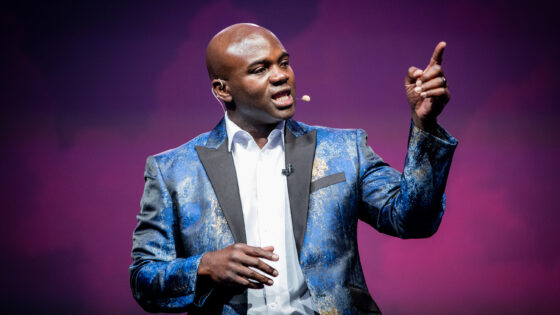
Today, Emmanuel Kulu Jr. stands at the intersection of multiple worlds: historian and educator, artist and activist, Cameroonian and American. His Forbes features and TEDx Talk are platforms for the message he’s dedicated his life to sharing.
The emergence of DEI (Diversity, Equity, and Inclusion) initiatives has given new credence to his work, providing frameworks for the African history he’s always championed. “If you don’t have the education that Africa is the common ground for all of our ancestry,” he notes, “You miss the foundation of human connection.”
As our conversation winds down, I’m struck by Emmanuel’s unwavering commitment in the face of resistance. “I believe it,” he says simply. “If you believe what you are doing, and you love what you are doing, you keep doing it.”
This is a blueprint for how we might all approach the work of truth-telling, with courage, with conviction, and with community always at the center.
The final scene isn’t an ending at all, but a continuation; Emmanuel Kulu Jr., standing where his father stood before him, speaking truth to power, and inviting us all to reclaim the history that belongs to everyone.
The camera fades to black, but the revolution continues…
Stay in the loop with exclusive news, stories, and insights—delivered straight to your inbox. No fluff, just real content that matters. Sign up today!