


In the dense Essequibo jungle, Amerindian communities live in a state of creeping dread. They watch the border as infrastructure and troops move closer, wondering if their homes will become the next frontline in a century-old dispute over oil-rich land. For these people, the high-stakes chess game between Caracas and Washington is an existential threat. This is how a slow-motion war begins; with the steady erosion of sovereignty.
This is how a slow-motion war begins; with the steady erosion of sovereignty.
For years, the pressure built like steam in a capped pipe. It was economic strangulation through sanctions that functioned like a siege without a single tank in the street. It was the “wild” chapter of Operation Gideon in 2020, where mercenaries and former U.S. Green Berets tried to snatch a president from a boat on the coast. That failed raid was no freelance fantasy; it was backed by a multimillion-dollar agreement and normalized in the halls of Washington power.
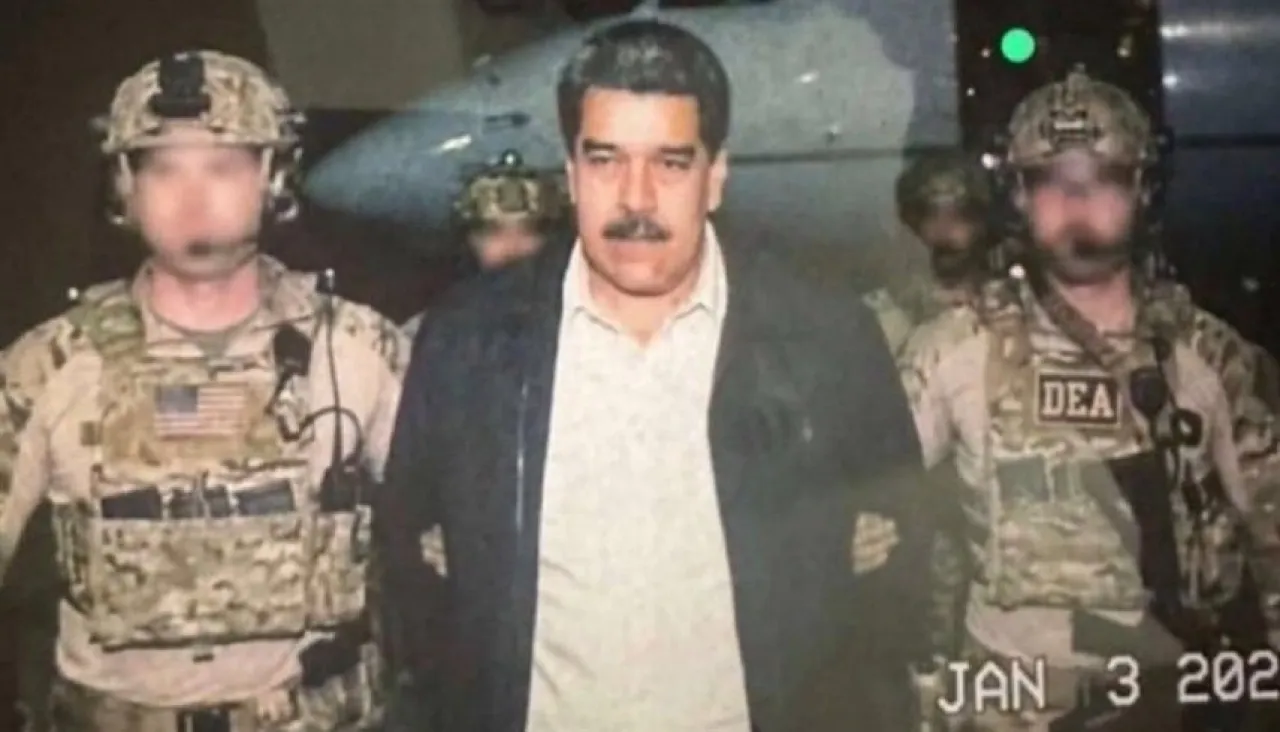
The game changed forever in early January 2026. U.S. military forces launched a large-scale strike on Venezuela. President Nicolás Maduro and his wife, Cilia Flores, were captured and extracted. They were flown under heavy security to New York to face the “full wrath” of a foreign justice system.
The transition from “covert plots” to direct seizure was framed as a law-enforcement operation against a “narco-terrorist regime.”
In a courthouse in the Southern District of New York, the charges are cold and clinical. Prosecutors say President Maduro spent 25 years turning his country into a protection racket for cocaine. They claim he partnered with the Cartel of the Suns and used military-grade weapons to protect the flow of “tons of cocaine” toward U.S. soil. His wife, Cilia Flores, is named as the fixer, the one brokering deals between traffickers and the state.

Now, the man who once controlled the world’s largest oil reserves sits in a cell facing potential life imprisonment. The streets of Caracas are left with a power vacuum. Washington has been clear about the next move: they intend to “run the country” until a transition can be organized. They are tightening the noose on the oil sector, ensuring that whoever comes next follows a different set of rules.
To understand this situation is to understand a high-stakes game of street-corner territory played out on a global map. Just as a powerful crew might squeeze a rival’s supply lines and wait for them to weaken before moving in to take the block, these global powers used sanctions and legal indictments to hollow out a nation before the final “snatch-and-grab.”
I wish I could say that this is a story about one man’s fall, but it is not. It is a warning sign for every resource-rich nation in the hemisphere. When a country tries to move independently, the “invasion” takes many forms. It comes as sanctions, it comes as “lawfare,” and eventually, it comes as a midnight strike. The ordinary people (the Afro-descendant, the Indigenous, and the poor) are the ones left to navigate the wreckage of a country being carved up by big-power games.
The illusion of sovereignty has been stripped away.
The illusion of sovereignty has been stripped away. Power takes what it wants and writes the charges afterward. In Toronto and across the Caribbean, the lesson is stark: in the world of empire politics, you are either at the table or you are on the menu.
Stay in the loop with exclusive news, stories, and insights—delivered straight to your inbox. No fluff, just real content that matters. Sign up today!









Colin A Campbell
January 6, 2026 at 8:41 pm
I would encourage every Canadian (and American citizens of good conscience) to avail themselves a copy of the late Michael C. Rupperts book : Crossing The Rubicon-The Decline of the American Empire At The End Of The Age Of Oil. The book is 600+ pages- and while it references perspectives about the circumstances surrounding the 911 attacks and Peak Oil theories -Mr Ruppert gifted the world (for those who will read) with a clear and cohesive roadmap directing the now unbridled and transparent ambitions of US foreign policy and global hegemony. The paragraphs at around Page 542-552 are particularly insightful given the recent events in the Caribbean in general and Venezuela in particular.
The paragraphs make it painfully clear that these were not recent decisions but rather the execution of long planned strategy and Canada needs to on guard and shed any naivete in this new world of openly hostile geo-strategic re-calibrations of global rule of law….
——//—
Snapshots from a future day in the United States of Amurderforhire
In a near future military court room, the JAG prosecutor asks: “ Admiral- Why did you believe your actions were warranted and more critically legal?” The Admiral responds “ I was just serving my country and following my superiors orders and I reject the implied characterization and premise of your question and invoke my Constitutional rights under the Fifth Amendment and Article 31 of the Uniform Code of Military Justice…
Simultaneously on the main street in Anytown, Idhao a reporter for the local tabloid is interviewing a female customer loading groceries into her vehicle in the west side parking lot of the Walmart, “What was your reaction to the news of the level of criminality committed by the federal government and the arrests of the key members of the administration?” Response: “We didn’t know-nobody told us nothing, I mean everybody knew they were all illegal invaders and narco-terorrists, the government said so -it’s the United States of Amurderforhire -not Russia for Chrissakes- we have democracy and trust the government and plus we got back our oil” …
CNN – Breaking news…armed mobs have descended on the nation’s Capital building in Washington and are locked in physical confrontations with the National Guard and Capital Police in what appears to be a replay of the 2021 January 6th riots just as the President is being sworned in…now heavy gunfire is being exchanged from automatic rifles…tear gas is being deployed…
Meanwhile, 750 kilometres away in Toronto, Ontario in the lineup at a Tim Hortons west of the of Yonge and Dundas intersection- a conversation: “Did’ja catch the game last night-Jeez Louise-could the line be any slower and I heard gas is going up again –doesn’t make sense with all the oil we have here”….