


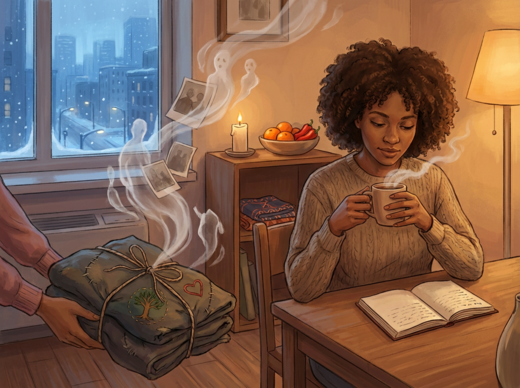

February has always felt like the month of reckoning to me. Not because of Valentine’s Day, or Black History Month (though both matters), but because February forces us to sit with ourselves in the dead of winter and ask the hard questions we’ve been avoiding since New Year’s resolutions failed.
This February, I’m asking myself: What am I still carrying that doesn’t belong to me?
Growing up Caribbean means inheriting more than recipes and accents. We inherit trauma wrapped in proverbs, pain disguised as protection, and survival strategies that once saved our ancestors, but now sabotage our peace. We carry our grandmothers’ fears of not being enough, our fathers’ anger at systems that diminished them, our mothers’ exhaustion from holding everyone together while falling apart inside.
The question isn’t whether we carry these things, but the question is whether we are ready to examine what we have been holding and decide what still serves us.
Last week, I sat in therapy talking about my relationship with money, and my therapist asked, “Where did you first learn that wanting more meant being ungrateful?” The answer hit me like a slap: Sunday dinner table, age seven, being told that “Wanting too much” was why slavery happened, why we had to leave home, why we could never get comfortable anywhere.
That belief served my family when resources were scarce, and survival meant being grateful for scraps, but in 2026, it’s keeping me small when I should be expanding. It makes me apologize for success when I should be celebrating it.
This is the work of Caribbean healing; distinguishing between ancestral wisdom that still serves us and ancestral wounds that limit us. Our grandparents’ caution about trusting systems was survival wisdom. Their fear of taking up space was a trauma response. We need to keep the wisdom, heal the wounds.
February’s short days force this kind of reflection. When there’s nowhere to hide in endless winter light, we must face what we’ve been carrying in the darkness, and for many of us, what we find is forgiveness work that we’ve been avoiding, because forgiveness feels like betrayal.

Here’s what I am learning: forgiving the people who hurt us isn’t about them, it’s about us. Forgiving the systems that failed us isn’t about absolving them, it’s about freeing ourselves. Forgiving our parents for passing down their unhealed trauma isn’t about excusing their choices; it’s about choosing differently for our own children.
The Caribbean women in my healing circle understand this in ways that mainstream therapy sometimes misses. We know that forgiveness doesn’t mean reconciliation. We know that setting boundaries with family can be an act of love. We know that breaking generational patterns requires grieving the family dynamics we’re choosing to let go of.
This February, I’m practicing what I call strategic forgiveness, releasing resentments that poison my peace while maintaining boundaries that protect my progress. I’m forgiving my parents for not knowing how to process their own trauma while refusing to inherit their coping mechanisms. I’m forgiving myself for repeating their patterns while committing to interrupting them.
February is also Black History Month, which means we’re celebrating our ancestors while acknowledging their struggles, but what if this year, instead of just honouring their resilience, we also honoured their need for healing? What if we celebrated not just their ability to survive, but also our ability to thrive by doing the emotional work they didn’t have time or tools for?
The healing happens when we realize that forgiveness is the ultimate act of revolution. When we forgive, strategically, we break cycles. When we release what doesn’t serve us, we make room for what does. When we stop carrying other people’s pain, we free up energy to have our own dreams.
February’s gift is its brevity; 28 days to practice forgiveness before spring demands growth. Use them wisely.
Stay in the loop with exclusive news, stories, and insights—delivered straight to your inbox. No fluff, just real content that matters. Sign up today!