
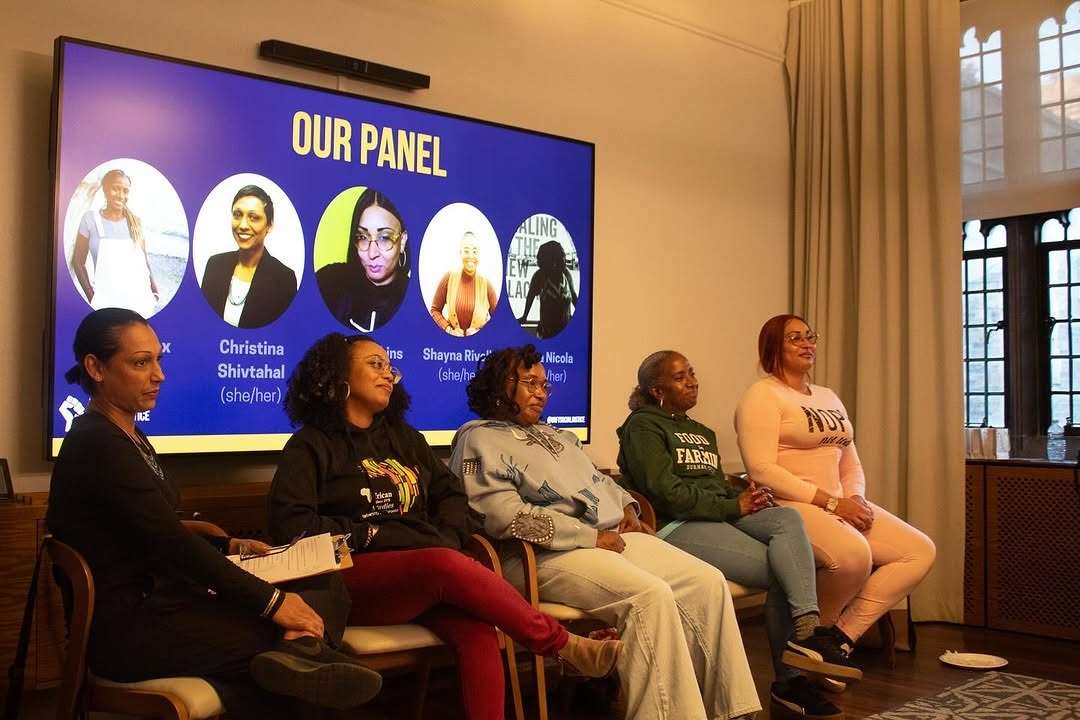

A couple weeks ago, something beautiful happened in the Burwash Room at Hart House. The West Indian Students Association and Hart House Social Justice Committee brought together Caribbean women, scholars, and community members for “In Her Voice: Caribbean Feminisms and Futures,” and what unfolded was nothing short of transformative.
As one of the panelists, I walked into that room carrying my own story: a Jamaican woman who returned to university at 44, a mother of four, a recovery warrior, and someone who has spent years learning that healing is political. I left that evening, reminded of something I always knew but sometimes forgot when Caribbean women gather to share truth, we heal each other.
The conversation meandered like the best Caribbean gatherings do, from migration stories to the politics of food, from academic achievements to childhood memories of grandmothers’ wisdom. Natalie spoke about growing culturally appropriate foods and how her grandmother’s roti-making became a connection to identity across continents. Christina shared research on her maternal grandparents’ journey as indentured labourers, illustrating how academic study can reclaim family histories often lost to colonial silences.
“We are not one another’s enemies. Community is something that is a necessity to survive, just like air, and how strong we are together.”
What struck me most was how each woman’s story of migration, whether forced, chosen, or inherited, became a testament to the resilience and innovation of Caribbean women. We discussed how our mothers and grandmothers transformed it into an opportunity, turning domestic work into networks of support, sending remittances that built communities, and creating susu systems that sustained families across borders.
We also didn’t shy away from brutal truths. We named internalized oppression, colorism within our own communities, and what I call “self-colonialism” the ways we sometimes perpetuate the very systems that harm us. Moka spoke powerfully about intersectionality, advocating for LGBTQ+ rights while navigating Caribbean identity. Shaina challenged us to think about class privilege within Caribbean communities, sharing how growing up middle-class in Trinidad still meant facing racism abroad.
The evening included a beautiful exercise where we honoured Caribbean figures who inspire us. I lifted up three women: Joyce (my mother), Lolita, and Nanny of the Maroons, the women who shaped everything I am today. Others honoured grandmothers, teachers, and even Tessanne Chin, whose representation on The Voice showed young Caribbean girls that we belong on world stages.
Food emerged as a recurring theme, not just sustenance, but resistance, identity, and healing. From scotch bonnet peppers to saltfish preparation, from community gardens to fighting for culturally appropriate foods in Canadian institutions, we explored how what we eat connects us to who we are. It’s why finding proper scotch bonnets in Toronto grocery stores matters. It’s why teaching our children to cook traditional foods is an act of cultural preservation.

Perhaps most importantly, we talked about education as liberation. Several of us were “non-traditional” students who found our way to university later in life, proving that it’s never too late to reclaim knowledge that was always ours. We discussed how accessing education, whether through programs like the University of Toronto’s Transitional Year Programme, or simply community storytelling, becomes a tool for healing generational trauma.
The event reminded me why I believe healing is the new black. When we create spaces for authentic conversation, when we honour our mothers’ and grandmothers’ wisdom while pursuing our own growth, when we support each other’s journeys without judgment, that’s when transformation happens.
For Toronto’s Caribbean community, events like this matter because they center our experiences, our struggles, and our brilliance. They create space for the full spectrum of Caribbean womanhood, from the student to the elder, from the artist to the academic, from the activist to the entrepreneur.
As we face ongoing challenges, from climate change affecting our home countries to systemic racism in our adopted ones, gathering in community becomes essential. We need spaces where our stories matter, where our healing is prioritized, and where our futures are collectively imagined.
The conversation continues beyond that evening. It continues in our families, our workplaces, our communities. It continues every time we choose to support one another rather than compete, every time we share knowledge rather than hoard it, and every time we create rather than destroy.
When Caribbean women heal together, we heal the world.
Stay in the loop with exclusive news, stories, and insights—delivered straight to your inbox. No fluff, just real content that matters. Sign up today!