

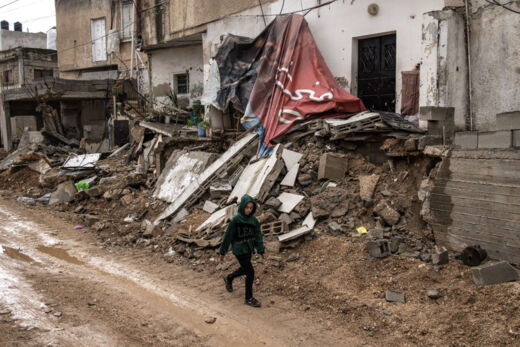

Children who are being forcibly displaced from three refugee camps in the northern West Bank are showing alarming signs of psychological distress.
Imagine losing everything and everyone around you. All the hope, all the strength you once had slowly being ripped straight out of your soul. Imagine being stripped bare with nothing but this dead numbness that gnaws at you day by day. The sinking feeling you have knowing you won’t ever get to snuggle in your moms’ arms and breathe in the scent of home. Instead, all that’s left is the faint smell of war in the air. All the rubble, the dirt and the blood mixed together in one rebelling force.
The children were among up to 32,000 people, including an estimated 12,000 children, who fled the Jenin, Tulkarm and Nur Shams refugee camps when Israeli forces launched a large-scale military operation, known as Iron Wall, aimed at targeting militant groups. The United Nations reported that the operation resulted in 64 deaths, including 11 children, and triggered the largest wave of displacement in the West Bank since 1976.
At this time, we have to sit and really ask ourselves is this any way for anyone to live, let alone small children who have done no harm to anyone or anything, and now? They sit in the bloodbath of their moms, dads, sisters, brothers and all people who they used to love.

Save the Children staff working with displaced families in Nablus reported that many children are refusing to attend school, experiencing emotional distress and regressing developmentally. Bedwetting, a common stress response in children, has increased significantly, alongside changes in eating habits and behaviour.
Many displaced families are now living in overcrowded apartments with relatives or in temporary shelters such as vacant university dormitories. “With homes destroyed and infrastructure severely damaged, returning to the camps remains impossible,” the organization said.
Hala, 15, who was displaced with her parents and five siblings, described the emotional toll of repeated moves and disrupted education. “We’ve been moved from one environment to another, from one life to another,” she said. “It affected our mental wellbeing; in how we eat, in our emotional state, in everything.”
Her brother Salah, 16, has become increasingly withdrawn, according to their mother Ikram, 36. “He just stays asleep all the time,” she said. “He doesn’t talk, even with us.”
Aid groups warn that the longer children stay displaced, the more lasting the harm will be to their mental health and education. Save the Children says food and shelter are not enough, and that families must be able to return home safely. Without action, many Palestinian children risk growing up with trauma that could affect them for the rest of their lives.
Stay in the loop with exclusive news, stories, and insights—delivered straight to your inbox. No fluff, just real content that matters. Sign up today!