

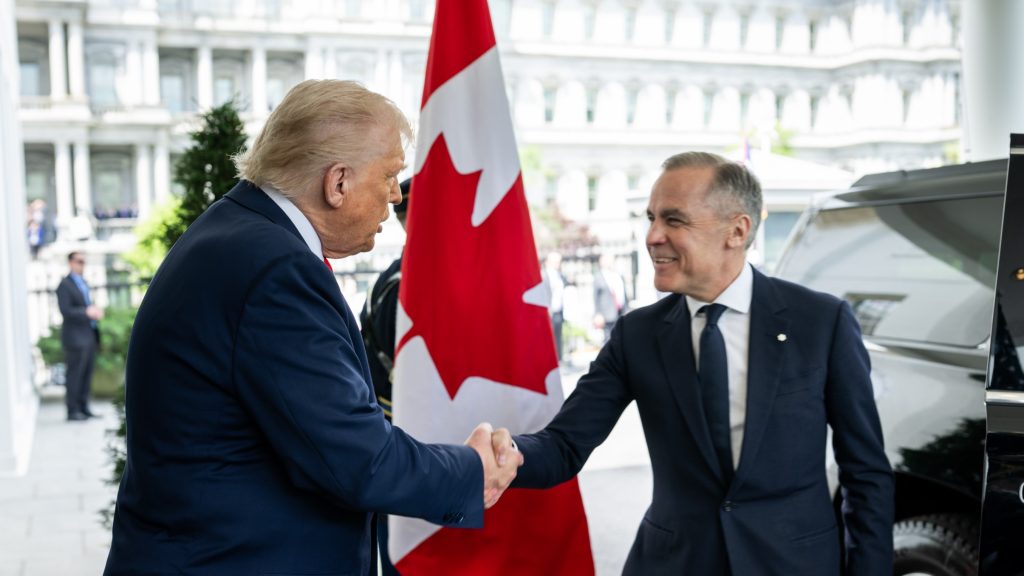

What do you mean, “Trump joins Alberta?” Isn’t Alberta a province of Canada?
The short answer is yes, on both counts, but the longer answer opens a much deeper political rabbit hole.
Canadians have seen this movie before. Quebec spent decades flirting with separation, holding referendums that nearly split the country in two. Now, it appears the separatist bug may have spread westward to Alberta.
How serious is Alberta about leaving Canada?
Alberta separatist groups have reportedly met several times with U.S. government officials to discuss the idea of independence. That alone set off alarms in Ottawa. Prime Minister Mark Carney responded by stressing sovereignty, “I expect the U.S. administration to respect Canadian sovereignty. I am always clear in my conversations with President Trump to that effect, and then move on to what we can do together.”
British Columbia Premier David Eby went further, calling the meetings dangerous and disloyal, “We’ve got free speech, that’s important, but to go to a foreign country and ask for assistance in breaking up Canada… there’s an old-fashioned word for that, and that word is treason.”
Separatists in oil-rich Alberta argue they are over-taxed and under-represented in Confederation. While the White House has admitted meeting with civil society groups, officials refuse to say what was discussed.
Meanwhile, Alberta has approved a petition process for a potential independence referendum. Activists have until May to gather 178,000 signatures from eligible voters.
The Alberta Prosperity Project (APP), the main group pushing for a vote, has openly sought U.S. support. Its leader, Jeffrey Rath, says they plan to request a $500-billion U.S. credit line if a referendum moves forward.
Premier Danielle Smith says she does not support separation. Still, an Ipsos poll suggests about 28% of Albertans might vote “yes” in a referendum. “When you look at the polls, they suggest as many as 30% of Albertans have lost hope; that’s about a million people,” Smith said. “I’m not going to demonize or marginalize a million of my fellow citizens when they’ve got legitimate grievances.”
Why Alberta matters so much
Let’s be blunt: the U.S. interest in Alberta would be about resources. Alberta produces over 80% of Canada’s oil and about 60% of its natural gas. According to the Canadian Energy Regulator, roughly 87% of Canada’s crude oil (about 3.3 million barrels per day) goes to the U.S., and most of it comes from Alberta.
This is power, leverage, and money.

A country under strain
Canada is already under pressure: tariffs, housing shortages, immigration system failures, and rising poverty. Now, with Quebec historically restless and Alberta openly flirting with separation, the federation itself feels fragile.
Many Albertans believe Ottawa takes more than it gives. When people feel unheard long enough, the ground beneath the country starts to crack.
What needs to change
Canada cannot afford silence anymore, especially when the U.S. acts in ways that destabilize smaller nations and regions.
From Caribbean states being pressured into accepting deportees, to tourism blacklists, to economic coercion in the name of security, the pattern is familiar: pressure first, control later.
If Canada believes staying quiet will keep it safe, it’s mistaken. History shows that those who refuse to speak up eventually get spoken for.
Alberta is the warning sign.
The legal and economic reality check
It is important to understand that separating from Canada is a constitutional earthquake. Under Canadian law, a province cannot unilaterally leave the federation. Any attempt at secession would require complex negotiations with Ottawa, the consent of Parliament, and likely a national constitutional process. In other words, even if a majority of Albertans voted “yes,” independence would not happen overnight.
There are also serious economic realities to confront. Alberta benefits enormously from being part of Canada’s internal market. It trades freely with other provinces, relies on federal infrastructure spending, and benefits from national regulatory frameworks that support energy exports. Independence would mean renegotiating trade access, currency systems, border controls, and defense arrangements, all from scratch.
An independent Alberta would also face immediate questions: What currency would it use? Would it keep the Canadian dollar, adopt the U.S. dollar, or create its own? Who would pay for pensions, healthcare, and federal transfers currently funded through national programs, and how would Alberta manage national debt obligations?
These concerns shape whether an independent Alberta would actually be stronger, or more vulnerable.
History shows that separatist movements often grow during moments of economic frustration and political alienation, but frustration alone does not build a country. Institutions, legal frameworks, and economic stability do.
That’s why Alberta’s separatist push is a stress test of Canada’s political maturity, its ability to listen to regional grievances, and its willingness to reform without breaking apart.
What a Trump – Alberta alliance would mean
At Davos, former U.S. President Donald Trump said, “Canada lives because of the United States. Remember that, Mark, the next time you make your statements.” Those words were not accidental. They reflect a worldview that sees neighbouring countries as dependents, not partners.
For Canada, an Alberta-Trump alignment would mean losing coherence, leverage, and the ability to act as a mid-sized power. For Caribbean nations and diasporas, it signals that the same forces (economic pressure, nationalism, and transactional politics) are tightening the squeeze from the north.
If smaller and mid-sized nations do not stand together, they will be picked apart, province by province, island by island. Canada is not immune. Alberta is not the disease. It’s a symptom, and symptoms, if ignored, become something far worse.
Stay in the loop with exclusive news, stories, and insights—delivered straight to your inbox. No fluff, just real content that matters. Sign up today!