


Connect with us

Subscribe

Subscribe

Business

Collaborative Science is shaping healthier futures for our communities

“When you invest in scientific infrastructure, you’re investing in possibility.”

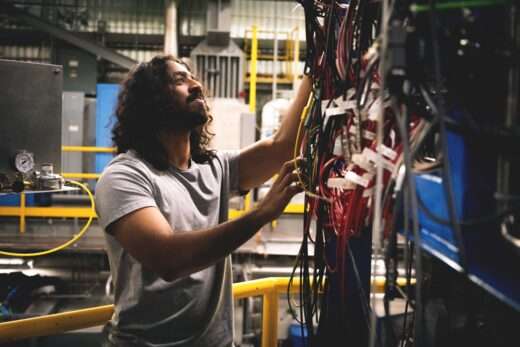
Photo Courtesy of TRIUMF | Canada’s Particle Accelerator Centre – Canada's Particle Accelerator Centre

We applaud people solving problems who are: focused, efficient, and fast. I was recently reminded that progress doesn’t always follow a straight line. Before investigators can conduct studies that yield breakthroughs, they often need others to finance and build major research infrastructure. It takes time, with various stops and starts, different collaborations often involving many institutions and countries, and not always a clear sense of direction.

TRIUMF, Canada’s national particle accelerator centre in Vancouver, a partnership of 21 universities, enables study on the inner workings of atoms. The high-energy cyclotron technology developed there, and the specialists trained to use it, produce lifesaving isotopes used to diagnose cancer and guide treatment. As Dr. Lisa Kalynchuk, Vice-President of Research & Innovation at the University of Victoria, put it to me: “When you invest in scientific infrastructure, you’re investing in possibility. You can’t always predict where breakthroughs will appear, but you can create the conditions for them to flourish.”

The Canadian Light Source in Saskatoon is a synchrotron, essentially a machine that bends electrons until they emit intense light. It was built to explore the physics and chemistry of advanced materials, enabling researchers to visualize viruses, investigate chronic lung disease, and understand how drugs interact with the body. Infrastructure constructed for physics and engineering research functions as a lab for understanding human life.

The International Space Station is an example of extraterritorial international collaboration at the frontiers of scientific exploration. It is also a health lab. Astronauts lose bone density rapidly in microgravity, so efforts to keep them strong have helped with osteoporosis, frailty, and aging here on Earth.

When you invest in scientific infrastructure, you’re investing in possibility.”

Ocean Networks Canada collects and shares data about all aspects of the ocean. The seas are a source of medicines for cancer treatment, new sustainable materials from kelp, renewable energy that reduces the negative health effects from burning fossil fuels, resources to reduce food insecurity, and adapting ocean life systems to better understand human health. The unusually large nerve fibres of squid, for example, made it easier for scientists to understand the electrical basis of the nervous system, knowledge that is shaping treatments for epilepsy, depression, and Parkinson’s disease.

Some of the greatest breakthroughs in human health have arrived not by design, but by accident, provided an inquisitive mind was paying attention. Alexander Fleming wasn’t searching for the world’s first antibiotic when he returned from holiday to find that a wandering mold had killed bacteria on a petri dish. Yet penicillin went on to prevent more deaths than we can count. As Louis Pasteur once said, “Chance favours only the prepared mind.”

Increasingly, big science facilities throw researchers from different domains together, triggering unexpected and important outcomes.

“Chance favours only the prepared mind.”

These examples remind us why we must invest in large scale research collaboration even when the practical benefits are not obvious. It’s tempting to demand that every dollar be tied to a clear payoff. History teaches the opposite. Discoveries emerge when we give scientists the freedom to ask bold questions, even ones that seem unrelated to human health. To insist that research must always serve a tidy, immediate purpose is to miss the possibility of much more.

Most people will never see a cyclotron, or synchrotron at work. Very few will set foot on the Space Station, but many are benefitting. The decisions made years earlier, that few noticed, debated, or celebrated, have delivered health advances that now touch almost all of us.

The next time we hear about governments debating billions in scientific infrastructure, we might remember, these aren’t abstract investments. They are the seedbeds of discoveries that one day may save our lives.

Newsletter Signup

Stay in the loop with exclusive news, stories, and insights—delivered straight to your inbox. No fluff, just real content that matters. Sign up today!


Dr. W. Gifford-Jones, MD is a graduate of the University of Toronto and the Harvard Medical School. He trained in general surgery at Strong Memorial Hospital, University of Rochester, Montreal General Hospital, McGill University and in Gynecology at Harvard. His storied medical career began as a general practitioner, ship’s surgeon, and hotel doctor. For more than 40 years, he specialized in gynecology, devoting his practice to the formative issues of women’s health. In 1975, he launched his weekly medical column that has been published by national and local Canadian and U.S. newspapers. Today, the readership remains over seven million. His advice contains a solid dose of common sense and he never sits on the fence with controversial issues. He is the author of nine books including, “The Healthy Barmaid”, his autobiography “You’re Going To Do What?”, “What I Learned as a Medical Journalist”, and “90+ How I Got There!” Many years ago, he was successful in a fight to legalize heroin to help ease the pain of terminal cancer patients. His foundation at that time donated $500,000 to establish the Gifford-Jones Professorship in Pain Control and Palliative Care at the University of Toronto Medical School. At 93 years of age he rappelled from the top of Toronto’s City Hall (30 stories) to raise funds for children with a life-threatening disease through the Make-a-Wish Foundation.  Diana Gifford-Jones, the daughter of W. Gifford-Jones, MD, Diana has extensive global experience in health and healthcare policy.  Diana is Special Advisor with The Aga Khan University, which operates 2 quaternary care hospitals and numerous secondary hospitals, medical centres, pharmacies, and laboratories in South Asia and Africa.  She worked for ten years in the Human Development sectors at the World Bank, including health policy and economics, nutrition, and population health. For over a decade at The Conference Board of Canada, she managed four health-related executive networks, including the Roundtable on Socio-Economic Determinants of Health, the Centre for Chronic Disease Prevention and Management, the Canadian Centre for Environmental Health, and the Centre for Health System Design and Management. Her master’s degree in public policy at Harvard University’s Kennedy School of Government included coursework at Harvard Medical School.  She is also a graduate of Wellesley College.  She has extensive experience with Canadian universities, including at Carleton University, where she was the Executive Director of the Global Academy. She lived and worked in Japan for four years and speaks Japanese fluently. Diana has the designation as a certified Chartered Director from The Directors College, a joint venture of The Conference Board of Canada and McMaster University.  She has recently published a book on the natural health philosophy of W. Gifford-Jones, called No Nonsense Health – Naturally!

Click to comment

Leave a Reply

Your email address will not be published. Required fields are marked *

Trending

Who protects journalists when truth becomes a death sentence?

News & Views

Rising Stronger: The Resilient Heartbeat of an Island Home

JamaicaNews

Black Excellence isn’t waiting for permission anymore; It’s redefining Canada

Likes & Shares

Over 100 global affairs workers expose systemic racism scandal

News & Views

Newsletter Signup

Stay in the loop with exclusive news, stories, and insights—delivered straight to your inbox. No fluff, just real content that matters. Sign up today!

Legal Disclaimer: The Toronto Caribbean Newspaper, its officers, and employees will not be held responsible for any loss, damages, or expenses resulting from advertisements, including, without limitation, claims or suits regarding liability, violation of privacy rights, copyright infringement, or plagiarism. Content Disclaimer: The statements, opinions, and viewpoints expressed by the writers are their own and do not necessarily reflect the opinions or views of Toronto Caribbean News Inc. Toronto Caribbean News Inc. assumes no responsibility or liability for claims, statements, opinions, or views, written or reported by its contributing writers, including product or service information that is advertised. Copyright © 2025 Toronto Caribbean News Inc.

Connect
Newsletter Signup

Stay in the loop with exclusive news, stories, and insights—delivered straight to your inbox. No fluff, just real content that matters. Sign up today!