


The air in the basement was thick with the heat of a Scarborough summer, but with the heavy, rhythmic thrum of a bassline that felt like a heartbeat. Young Paul Bennett stood behind the decks, his hands trembling so violently he could barely pick up the needle. He wasn’t a legend yet. He was just a kid from Highland Creek Public School, an athlete who lived for the rush of the track and the height of a basketball rim, suddenly finding himself in the shadow of his neighbour Jason Hyde, known to the streets as Rocky P.
In those early days, Paul was the extra, the quiet observer in Jason’s father’s basement, learning the secret language of records and scratches while other kids played tag upstairs. He was the athlete who watched Ben Johnson and learned that speed was nothing without a clean start. As he stood there, hands shaking, coaching himself through the nerves, a transformation was beginning. He didn’t know then that he was destined to move from the trembling hands of a novice to the crushing energy of a master who would eventually be banned from venues because the crowd’s reaction was too powerful for the architecture to hold.
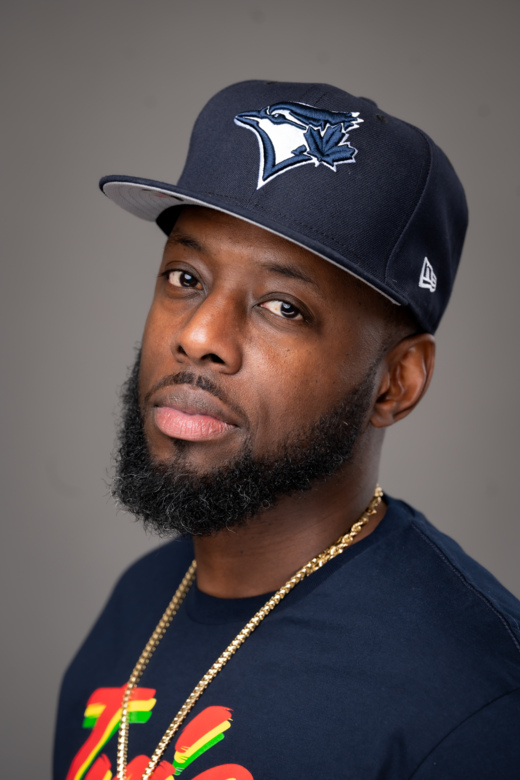
To understand the man, you have to understand the soil. Chris Dubbs wasn’t born in the Caribbean; he was born in Kitchener, Ontario, a place his parents eventually left because they were “The only other Black people in the building.” Even in that isolation, the universe was positioning him for greatness. His babysitter wasn’t just anyone; it was a young Lennox Lewis. The future heavyweight champion’s mother lived in the same building, and Paul’s father would drive Lennox to boxing practice while the future champ watched over the boy who would one day become a heavyweight in his own right, in the world of sound.
When the family moved back to Scarborough in grade one, Toronto became the canvas for the myth. It was a Jamaican household where culture was a dual citizenship. Paul learned to navigate the white spaces of Kitchener and the community-rooted streets of Scarborough, a duality that would later define his signature energy. He was a student of the 48 Laws of Power before he ever read them, observing how his parents navigated a world that did not always welcome them, and how music could become a fortress of identity.
The moment Paul became “Chris Dubbs”
The transformation from Paul to the brand was a strategic pivot. In high school, he was Rizzla, a name that carried local respect but lacked the commercial catch he craved. He realized that to reach the top, he had to recreate himself (Law 25 of the 48 Laws of Power). He needed a name that sounded like music and felt like rhythm. He drew inspiration from the 90s slang where “Cris” meant something was clean, fresh, and undeniable. Combined with his obsession for dubplates and the small-island term for reggae (dub music) Chris Dubbs was born.

The shift from local kid to wider recognition happened at a UofT barbecue. He was just a grade 10 student, but he was brought in to play alongside the big names of the era, Jester and the Worldwide crew on 89.5 FM. “My hand a shake,” he remembers, but when he dropped the needle, he “Played across the place.” That night, the feedback was a mandate. He was invited to Windsor, then Montreal, and eventually, the legendary G-Spot in Toronto.
At the G-Spot, the myth turned into legend. He played a set so bad (in the best way possible) that the crowd began banging on the glass-covered walls. The walls shattered. The venue owners, unable to handle the unruly energy of a Dubbs set, banned him, but you can’t ban a vibe that has already infected the city. From The Guvernment to Six Degrees, Chris Dubbs became the roadblock DJ.
What makes him different? It’s the Jamaican commercial style. He can talk the patois of the foundation and then switch to the proper lexicon of a professional, leaving people confused but captivated. He messed with people’s heads, showing them “He has sense, but mi bad.” It is an emotionally intelligent approach to the decks; he reads the reaction of the crowd as a journalistic tool.
He isn’t a safe DJ. While others play the hits to get by, Chris Dubbs plays to crush the dance. He understands that great writing (and great DJing) is about the takeaway. He wants you to remember the feeling of the bass in your chest long after the lights come up. His council includes the greats: the Bob Marleys and Marcus Garveys, whose spirits he channels when he spins tracks like Dennis Brown’s Love and Hate.
Today, the empire of Chris Dubbs is a labour of love that spans the globe. He founded Reggaetown Radio, a 24/7 digital fortress that ensures reggae is accessible to everyone, from the UK to Japan, but his true impact is seen in the shadows, where he puts money in every reggae DJ’s hand. In an industry he describes as very selfish, he chooses to be the mentor, the one who tells a young DJ to “Pay your credit card bill” and “Govern your life” before they get lost in the hype.
During the pandemic, he pivoted again, conquering Twitch and building an international community that once followed him through a mall in England because they recognized his livestream. He helped a corporate worker named Annabella find her footing in the DJ world, watching her go from three viewers to being sponsored by Adidas. He writes his own story by healing divisions, using his platform to elevate others because he knows that the years fly and your legacy is only as strong as the people you help along the way.
Looking 20 years into the future, Chris Dubbs isn’t worried about the accolades. He wants to be remembered as a genuine person who appreciated the people more than the industry. He is a strategic storyteller who understands that while the music might suck right now and the world is getting more expensive, a good energy never goes out of style.
He is no longer that shaking kid in a Scarborough basement. He is the man who turned Toronto into a reggae myth, who was babysat by a legend, and who became one himself. He is Chris Dubbs, and he is just getting started.
Music is a lifestyle. It is an infatuation, and a life-long love. He is determined to share the soul of reggae music until the very end. The dance isn’t over; the needle is just finding the groove.
Stay in the loop with exclusive news, stories, and insights—delivered straight to your inbox. No fluff, just real content that matters. Sign up today!