

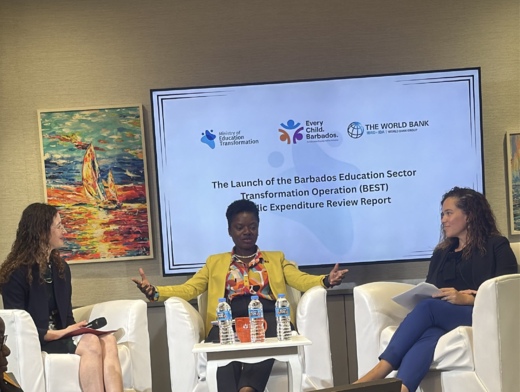

A press release issued on Wednesday, May 27th, 2026, has drawn renewed attention to a World Bank Group review of public expenditure in Barbados’ education sector. The report, Navigating Change: Review of Education Expenditure and Resilience in Barbados, authored by V.L. Marston, K. Acevedo, and A. Latootue, delivers a data-driven assessment of how effectively the country’s education investments are translating into outcomes.
At its core, the review examines whether current spending supports learning achievement, equity, workforce readiness, and long-term system resilience. Its release coincides with the launch of the Barbados Education Sector Transformation (BEST) program, which aims to align education with national development priorities and the demands of a global, knowledge-based economy.
Despite strong fundamentals, the findings are clear: the system is not delivering at the level required for the future.
“Barbados stands at a critical juncture in its educational journey,” the press release states. “Despite high enrolment and completion rates in primary and secondary education and relatively high levels of education spending, the current system is not delivering on its mission of adequately preparing students for the demands of a modern, knowledge-based economy.”
Barbados has long been regarded as a regional leader in education. The country spends approximately 4% of its GDP on education (consistent with international benchmarks) and allocates BBD 594.6 million annually, representing 13.8% of total government expenditure. This sustained investment has produced near-universal enrolment and strong completion rates at both primary and secondary levels.
However, the report highlights critical gaps beneath these achievements.
While access is nearly universal, performance disparities remain significant. Roughly 70% of students meet expected benchmarks in end-of-primary assessments, leaving 30 percent below standard. This gap raises concerns about foundational literacy and numeracy, particularly as students transition through the system.
Equally pressing is the disconnect between education and employment. The report identifies a mismatch between the skills students acquire and those demanded by the modern workforce. Without targeted reforms, this gap risks limiting national competitiveness and economic growth.

To address these challenges, the review outlines several priority areas for reform:
- First, early childhood education must be expanded. Underutilized primary school spaces could be repurposed into nursery classrooms, increasing access to early learning and strengthening foundational development.
- Second, the system requires more targeted remediation. Early diagnostic assessments are essential to identify literacy and numeracy gaps and enable timely, evidence-based interventions.
- Third, teacher development must be standardized and strengthened. A national teacher policy focused on professional standards, continuous training, and performance incentives would help elevate instructional quality across the system.
- Finally, infrastructure must be adapted for climate resilience. Upgrading school facilities to withstand environmental challenges, while ensuring universal accessibility, is critical for long-term sustainability.
Lilia Buruncius, World Bank Director for the Caribbean, underscored the urgency of reform, “Barbados has built a strong foundation but must now focus on quality, equity, and resilience to ensure students are equipped for a changing economy. The Barbados Education Sector Transformation Program will support the implementation of these reforms, positioning Barbados to strengthen its workforce and global competencies.”
The report also raises equity concerns. While educational opportunities exist, access to scholarships and advanced pathways appears uneven, with students from higher-income families more likely to benefit. Addressing these disparities will be essential to ensuring that progress is inclusive.
Barbados stands on the threshold of transformation. Its education system has delivered access and stability; the next phase must deliver excellence and relevance. Strengthening foundational skills, aligning education with workforce demands, and ensuring equitable access to opportunity will determine whether the country can fully realize its ambition of a world-class education system.
Stay in the loop with exclusive news, stories, and insights—delivered straight to your inbox. No fluff, just real content that matters. Sign up today!