
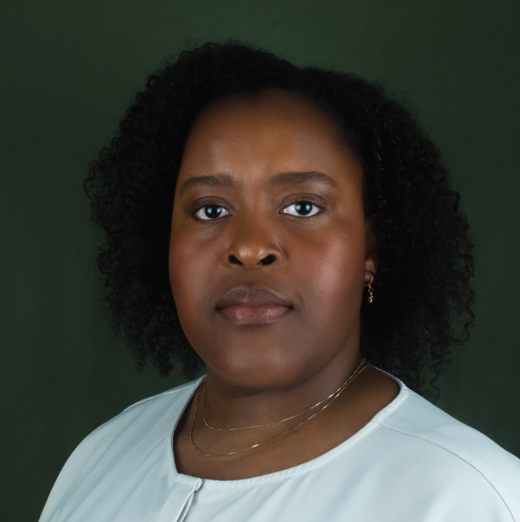

A concrete wall in St. Catherine, Jamaica, and exactly two seconds to arrange a face into a smile that was not there. This is the visceral anchor of Shiemara Hogarth’s latest work; a childhood photo of a quiet, forced performance. For Shiemara Hogarth, the 2026 Brampton Artist in Residence, memory is a strange and textured thing; it is a series of flashbacks attached to people and specific, often uncomfortable, feelings. In her studio, the act of creation is a cinematic interrogation of these warped memories. She is the curator of the narrative, using the haptic feedback of fiber to say what words cannot.
The doctrine of her upbringing was as rigid as that of a concrete wall, “You can’t make a living making art.” In the survivalist logic of the Caribbean diaspora, creativity was a dangerous luxury, a dead end that led away from the academic safety of becoming a doctor or a lawyer. She followed the script, arming herself with a history degree and mastering the analytical rigors of research, but the inner life is persistent. While she spent years working full-time in research and data analysis, she felt a profound disquietude; that internal signal Nir Eyal identifies as the engine of progress. She was achieving her goals, but she was suffering under the weight of an identity that was not her own.
Then came her emancipation. In an act of what she calls “Showing up for yourself,” Shiemara walked away from the safety of a full-time research career to return to art school. To her conservative community, this was a rejection of the viable life they had sacrificed to give her. It was a risk that mirrored the immigrant experience itself, a leap into the unknown with only your skills as a safety net. She was boldly reclaiming the silent, domestic creativity of the women who came before her.
Her mother meticulously sewed school uniforms and her grandmother crafted doilies with the precision of a master artisan, yet these women never dared to call themselves artists. Their creativity was hidden behind the label of utility, a quiet molding of the soul that Shiemara is now bringing into the light of public institutions. She realized that her lineage was full of design-thinkers who used material to solve the problem of living. By embracing textiles, Hogarth is mending a broken legacy, transforming women’s work into a powerful language of preservation and resistance.
In Shiemara’s hands, textiles become a tool for processing data through the fingertips. Words can be edited and reread, but the haptic experience of fiber is radically honest. When she weaves, she enters a flow state where the material itself dictates the story. There is a strategic power in this forced deceleration. In a world obsessed with hacking success and pushing autopilot buttons, Shiemara’s work is a lesson in the fragility of adaptation. She describes the technical heartbreak of working with linen: in the dry air of Alberta, the thread becomes brittle and snaps; in the humidity of Ontario, it softens. You have no choice but to be patient with the work. This is the diaspora experience distilled into a single strand: the constant, exhausting work of adapting to a climate that was never built for your survival.

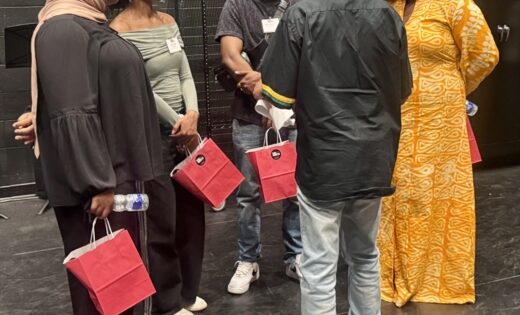
Shiemara’s legacy is not a solitary pursuit; she is a strategic community educator building a knowledge command center for those who have been systematically overlooked. By organizing “Canadian Women in Craft: A Conversation,” she intentionally cracked open the door for African Caribbean and racialized women in the Canadian art space. She understood that the assumptions of public institutions often cloud how African Caribbean women’s work is read. She wants the “Young Black girl” to see herself as an inheritor to the craft world. Her visibility is a tool for community empowerment, ensuring that the next generation understands that making is a valid way of claiming space.
She is a design-thinker who uses art as a shared practice rather than an individual one. During her residency, she invites the public into her process, hoping they leave with the understanding that they can be creative without it being a career, or a money-making venture. She wants to relax the brain and express the soul in a way that is not capitalist related. This is her quiet rebellion against a world that demands every second be productive and every hobby be monetized.
As she moves into her next chapter, Shiemara is looking back to move forward, planning to connect with untapped craft practitioners in Jamaica. She recognizes that her work has outlived the limiting beliefs of her childhood. She has replaced the “You can’t make money as an artist,” mantra with a liberating belief: that she can use her research background to amplify her art, and her art to heal the divisions of her own history. She is teaching us that beliefs are tools, and the most powerful tool we have is the ability to look at a concrete wall and see the possibility of a thread.
Ultimately, you, the reader, are the silent beneficiaries of Shiemara’s courage. Her narrative arc is a reminder that belonging is a work in progress, a cumulative process of testing materials and memories until they speak clearly enough to be heard. Her legacy is in motion, a testament to the fact that when you stop performing for the camera, you can finally start weaving a future of your own design. Shiemara Hogarth is mending the soul of the diaspora, one patient stitch at a time.
Stay in the loop with exclusive news, stories, and insights—delivered straight to your inbox. No fluff, just real content that matters. Sign up today!