

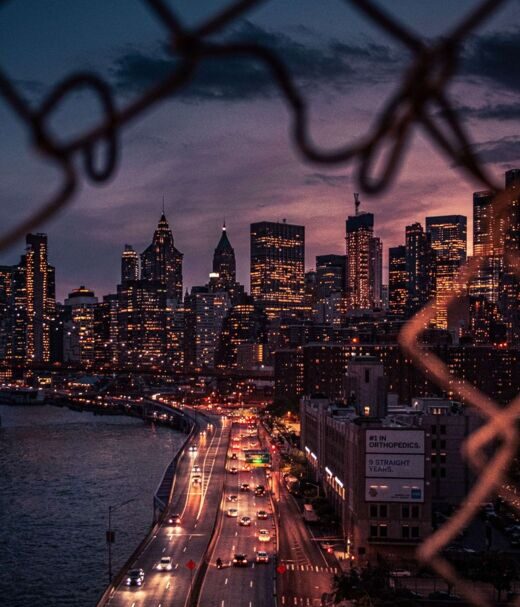

The Dark Skies Protection Act looks, at first glance, like an environmental fix, but for many people, especially those already living with fear, it raises a sharper question: who gets to decide what safety looks like after dark?
If this policy were coming to Toronto, would you feel safer with fewer lights, or more vulnerable? That is the emotional center of this debate, because lighting is about how people move through space, how they protect their homes, and whether they trust the state to make those decisions for them.
New York’s proposed Dark Skies Protection Act, introduced in early 2025 as Assembly Bill A4615 by Deborah Glick and Senate Bill S5007 by Brad Hoylman-Sigal, would create a new Article 18 in the Environmental Conservation Law. The bill would require outdoor lighting to be fully shielded by January 1st, 2028, so that 90% or more of light points downward instead of into the sky.
It also targets recreational facilities, including sports fields, if their lights do not meet shielding standards. Those lights would have to shut off from 11:00 p.m. to 5:00 a.m., unless they are motion-activated or active during events. The legislation also sets a 3000K cap on blue-rich lighting, limits glare and trespass, and calls for dimming where feasible.
Supporters say the law is a necessary correction to light pollution, energy waste, and the damage artificial light can cause to wildlife. They point to migratory birds, disrupted ecosystems, and the loss of night skies as public goods worth protecting. In that framing, the bill is pro-balance.
The deeper tension is social. When a government tells people their porch lights, floodlights, or facility lighting must be redesigned, lowered, shielded, or shut off overnight, it enters the most intimate layer of daily life: the feeling of being protected at home. For some residents, especially in dense neighbourhoods, light is reassurance.
That is why critics see the bill as a safety risk. They argue that dimmer streets and darker properties could increase burglary fears, trip hazards, and unease in communities where people already feel exposed. One of the strongest objections is psychological: people do not want to be told that they must trade visible security for an environmental ideal they did not choose.

There is also a governance problem. According to the material provided, the bill emphasizes education and DEC-led guidance rather than fines or criminal penalties. That softer approach may reduce fear of punishment, but it also raises questions about enforcement. Who decides what counts as compliance? Which neighbourhoods get told to change first? How evenly will a rule like this land across rural towns, suburbs, and high-density urban areas?
Those questions matter because policy never arrives equally. A law that seems elegant in principle can feel very different on a block where residents already worry about crime, where elders walk after dark, or where a storefront depends on visibility. In that sense, the bill becomes a test of whether environmental justice and public safety can be held in the same hand without one crushing the other.
The exemptions tell their own story. Highways, airports, emergency services, worker lighting, holiday decorations, Times Square, and some historical landmarks are carved out or allowed to seek waivers. That means the law already recognizes that not every space can be treated the same. The real issue is whether ordinary neighbourhoods will receive the same sensitivity.
This is where the politics of light become a politics of power. Who gets exemptions, who gets guidance, who gets burdened, and who gets to define the meaning of safe are not minor details. They are the law’s moral architecture. For Black and Caribbean communities, and for any community that has learned to question whether institutions see them clearly, this debate is larger than bulbs and fixtures. It is about whether policy makers understand that people who have lived with underprotection for them, sometimes darkness feels like neglect.
So, the real challenge is whether lawmakers can protect the sky without making ordinary people feel less secure on the ground. If New York gets this wrong, the law could deepen distrust. If it gets it right, it could prove that environmental care does not have to come at the expense of human dignity
Stay in the loop with exclusive news, stories, and insights—delivered straight to your inbox. No fluff, just real content that matters. Sign up today!