
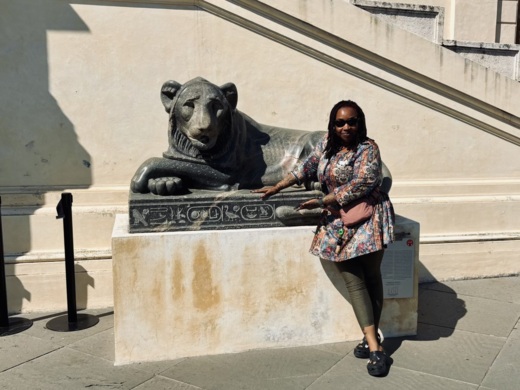

Standing in the Sistine Chapel last week, staring up at Michelangelo’s masterpiece, I felt something crack open inside my chest. Not spiritual reverence (though the art was breathtaking), but recognition. The angels, the saints, the biblical figures painted across that iconic ceiling were not just European faces telling European stories. They were us.
Our tour guide, an enthusiastic Roman historian, pointed out details I had never heard mentioned in any art history class. The Moors are depicted in Renaissance paintings throughout the Vatican. The hieroglyphics carved into Roman monuments that predate Christ. The African scholars whose mathematical and astronomical knowledge built the very foundations we were walking on.
For three days, I wandered through Rome seeing evidence of African brilliance everywhere: in the Colosseum’s engineering, in the Pantheon’s architecture, in countless paintings where Black figures were not servants or exotic curiosities, but kings, scholars, and saints. Yet somehow, none of this made it into the narrative I learned growing up.
How does an entire civilization’s contribution get erased so thoroughly that even we forget we were there?
This is what colonization does to memory. It steals stories. It makes you believe your people’s greatness is recent, accidental, or imaginary. It convinces you that your ancestors were primitive until Europeans civilized them, when the truth is that African knowledge systems were teaching Europe how to count, build, and navigate the stars.
Standing in those sacred spaces, I understood why healing our relationship with history matters so deeply for our community. When you do not know where your brilliance comes from, you start to question whether it belongs to you at all.
I see this in my practice all the time. Caribbean clients who have internalized messages that our cultures are less than: our accents need fixing, our traditions are not sophisticated, our ways of knowing are not legitimate. They carry shame about their heritage that is not theirs to carry.

What if we remembered that the same ancestors who survived the Middle Passage also built pyramids? What if we knew that the mathematical principles that got us to the moon came from African scholars? What if we understood that our grandmother’s bush medicine connects to healing traditions that taught the world about natural pharmacy?
The erasure was not accidental. When you convince a people, they have no history worth remembering, you make them dependent on others to define their worth. When you teach them, their ancestors were nothing, they become grateful for scraps of recognition instead of demanding their rightful inheritance.
This is why representation in textbooks matters. Why Afrocentric education isn’t radical, it is corrective. Why instructing our children about Mansa Musa, Queen Nzinga, and the University of Timbuktu is not mythology, it’s genealogy.
Here is what Rome taught me, beyond history lessons: our healing does not require anyone else’s permission or validation. The evidence of our greatness is carved in stone across the world. Our ancestors left receipts in mathematics, architecture, art, philosophy, and medicine that no amount of historical revisionism can erase.
When we heal our relationship with our past, we transform our relationship with our future. When young Caribbean people know they descend from civilizations that educated the world, they show up differently in classrooms. When we understand our cultures as a continuation rather than a deviation, we stop apologizing for taking up space.
The most revolutionary thing we can do is remember who we have always been. Not to make others feel guilty, but to make ourselves feel whole. Not to diminish other cultures’ contributions, but to reclaim our own.
Rome gave me new context for information that was always true. Our greatness is not breaking news. It is ancient history that never stopped being present reality. The question is: now that we remember who we are, what are we going to build?
Stay in the loop with exclusive news, stories, and insights—delivered straight to your inbox. No fluff, just real content that matters. Sign up today!