

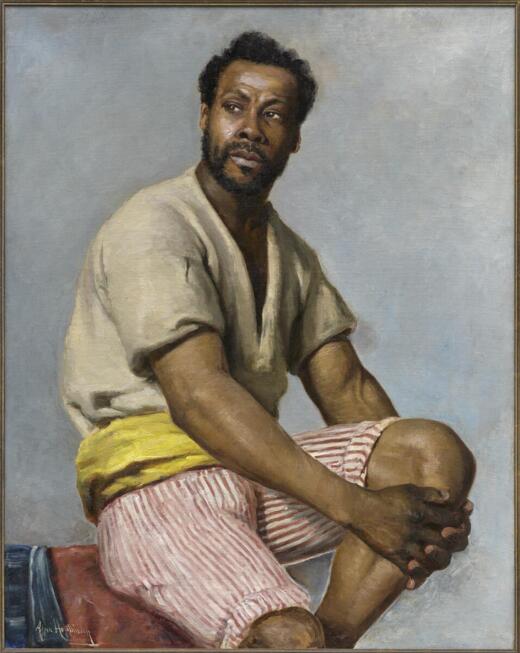

Before you even step into the gallery, imagine this: a man sits in a studio in Stockholm, 1879. His arms are strong from years of dock work, his gaze turned slightly over his shoulder, contemplative yet steady. Around him, a circle of young women, rare students at the Royal Swedish Academy of Fine Arts, raise their brushes. He is Pierre Louis Alexandre, an African man from French Guiana, and for decades he was the most‑depicted Black sitter in European art. Yet his name nearly vanished from history.
Alexandre’s life was extraordinary in its ordinariness. Born in Cayenne in 1844, he fled across oceans, arriving in Stockholm as a teenager. He laboured at the docks, enduring brutal winters that froze the port and left workers jobless. Then, in 1878, he was hired as a life model. For at least 15 years, he posed for Sweden’s leading artists: Anders Zorn, Oscar Björck, Karin Bergöö Larsson, and countless students. His pay doubled that of dock work. His image became ubiquitous. Yet his identity was fragile, recorded under shifting names, his presence reduced to the model.
Alma Holsteinson’s Portrait of Pierre Louis Alexandre (1879–80), now at the Art Gallery of Ontario, interrupts that erasure. Painted in a women’s studio class, it shows Alexandre as a man. His beige shirt, yellow sash, and red‑striped shorts frame a body rendered with care. The background (blues and greys like an overcast sky) accentuates his presence. Holsteinson’s empathy is palpable. She knew labour; she came from a mining family. Perhaps that is why she painted him not as a spectacle.
Museums have long treated Black sitters as exceptions. Alexandre’s portrait insists otherwise. He was not marginal to European art; he was central. Forty surviving works bear his likeness. He was, in effect, a 19th‑century top model, but visibility did not equal status. He remained economically precarious, socially erased, his descendants left with fragments of his story. The paradox is stark: high demand as a model, low recognition as a man.

Why does this matter now? Art history is not neutral. It is political. It decides whose faces hang on walls, whose names are remembered, whose labour is acknowledged. Alexandre’s portrait collapses the distance between past and present. It reminds us that the Caribbean and the Black Atlantic were always part of Europe’s art world, even when the canon pretended otherwise. His ancestors were trafficked by force; his own journey across the Atlantic was by choice. His presence in Swedish studios reveals how colonial migration and labour fed the very academies that produced classical art.
For Caribbean and diaspora audiences, this portrait is a conversation. It belongs in kitchens, in street corners, in church hums and market noise. Imagine the painting surrounded by zinc fence textures, dub rhythms, spoken word reflections. Imagine community voices layered into the gallery, “That’s my story too.” Art becomes dialogue. Ownership shifts. The painting is sold with audio archives, written reflections, and community contributions. It becomes living history.
Visitors should go see Alexandre’s portrait at the AGO for five reasons:
- To witness one of the rarest Black sitters in 19th‑century art.
- To reckon with how race and gender shaped art academies.
- To connect Caribbean histories to European collections.
- To experience how museums can activate old paintings socially.
- To support a re‑evaluation of whose portraits deserve walls.
Standing before Alexandre’s gaze, you feel the weight of history. You see a man who crossed oceans, who laboured, who posed, who survived. You see the brushstrokes of a woman artist whose own career was precarious. You see the intersection of race, class, gender, and art. You are asked: whose stories are we ready to see, and hear, next?
This portrait is not finished. It is alive. It is waiting for you.
Stay in the loop with exclusive news, stories, and insights—delivered straight to your inbox. No fluff, just real content that matters. Sign up today!